
August 25, 2012
Neil Armstrong
He got 'r done like Americans do.
Hangin' out on the moon, and living to be humble about it.
Forever Tranquility Base.
April 14, 2012
Indispensable tools
Harvey Miller's The Carpenter's Guide, online. It's all about how to build things the way they used to. Absolutely fabulous.
And, lastly but not leastly, thanks to the miracle of American Australian derring do and The Internets, a lovely Hip Roof (Imperial) rafter calculator. If you want to build a hip roof, that's almost all you need to figure it out. Other useful calculators there, too.
The art of the spar
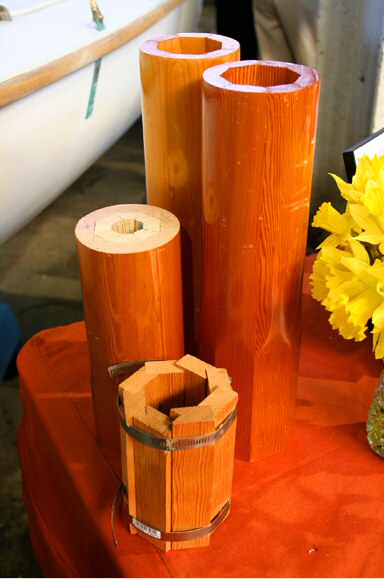
Here's how to turn square things into round things…
March 28, 2012
Flying Burrito ‘Copters?
January 16, 2012
“Dumb arguments”
Clay Johnson at The Information Diet closes out an otherwise revealing look at the bungle that is the federal government by swinging an inapt analogy around like a week old dead cat:
This is what happens when we focus on dumb arguments in Washington: in particular, the false choice of "Big Government" vs. "Small Government." When we talk about federal spending, we do it in a zero-sum way: "they're going to cut medicare and kill seniors" or "they want to pay poor people to have babies." But if think critically about the big v. small debate, you understand that it's stupid: I'm 6'2" and larger than average, but that has little to do with my intelligence or my ability to do my job. I don't get any better at it by cutting off my legs to be "smaller."
The problem is that the "Big" in Big Government is really used in reference to the scope of government, rather than its literal size, though I suppose some conflation of terms does occur. Still, people who rail against big government don't do so in the manner, "Well, the takeover of one seventh of the economy known as Obamacare would be swell if the resultant bureaucracy weren't so big." No, people deride government as big because it deigns to put its hands on one seventh of the economy in the name of reforming health care. And likewise, education, transportation, commerce, energy production, the kinds of cars we drive, how our showers work and our toilets flush, the food we eat, the lightbulbs we use, and soon, the web sites we visit.
Johnson's analogy would be better restated: I'm a smart guy with lots of skillz, but when I start thinking I can do my co-workers jobs, and our competitor's jobs, my boss's job, the janitor's job, etc., the company's output seems to suffer and people seem to resent it, so maybe I should think about downsizing.
Otherwise, excellent.
That link came via: TechDirt.
October 17, 2011
Meopta Universalni Hranolovy Kriz
The package arrived nearly two months late for my birthday (Little Bro, or Ivan Brosky, is always better late than never), and what the heck was it?
An army-style, steel box with no markings, and a thick, long canvas strap. Heavy.
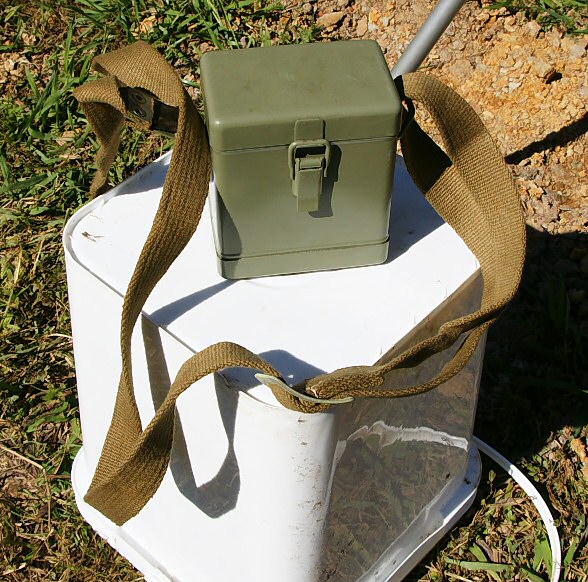
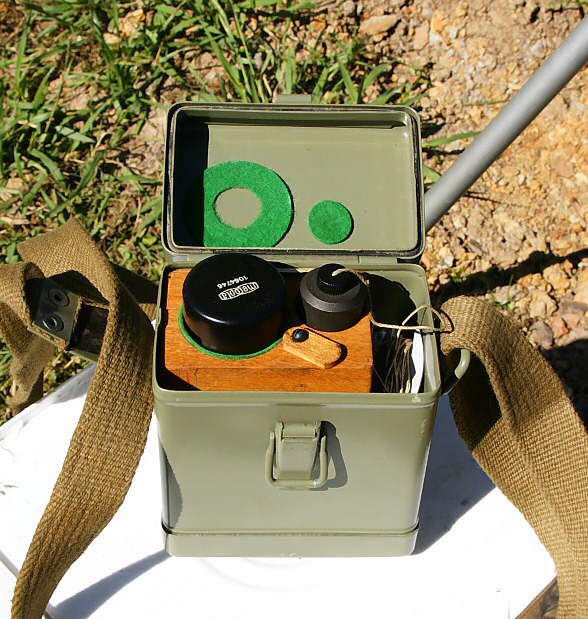
Opens to reveal two metal cylindrical objects (looking nebulously dangerous) precisely secured in a wooden form, along with a card specifying date of manufacture (30.3.56, a year and 60% after I was born) and other tid bits, a folded glossy (the fourth side blank except for a code number) info piece written entirely in Czech (or Slovak), and an ancient grease pencil/crayon with the broken tip rolling loose (the writing on the crayon is in English, so it may not be original. The box originally, possibly, contained two crayons).
I pulled the cylinder with the string out first, and it was plainly a plumb bob with plumb line (and sort of a carder (I think that's what it's called) which I must copy for my other bob lines). The larger cylinder turned out to be a complicated affair, with a hook on the bottom for the plumb line, a gimbal to allow a certain amount of rotation in establishing a vertical line, and windows at 90 degrees into the cylinder revealing a set of stacked prisms, variously etched with verticals and horizontals. Everything except the crayon in excellent condition. One face of one prism may be smudged. After almost sixty years.
Much attempted research ensued. There turned out to be exactly one clue on the Internet, seemingly an eBay thing, with the price obscured.
Intriguingly , the web site from which the gift was sent contained no reference to the item, nor to the other two unrelated items in the same birthday box.
Anyway, using Google Translate, Universalni Hranolovy Kriz translates as Universal Prismatic Cross, or something similar. It's a leveling device, or a sort of transit, for establishing elevations, and, in modern terms, a primitive one, though it is still a precision instrument.
It took me half a morning to first, track down all my various tripods, looking for the oldest one (which might also be from the fifties) and then to try to dismantle it to a useful state. I could NOT manage to remove the thin little ring clamp holding the thumb screw to the face of the tripod table, but did finally ascertain that it accepted a 1/4 inch 20 thread bolt, and so was able (with a one inch spade to drill the hole to accept the gimbal) to rig the set up below.
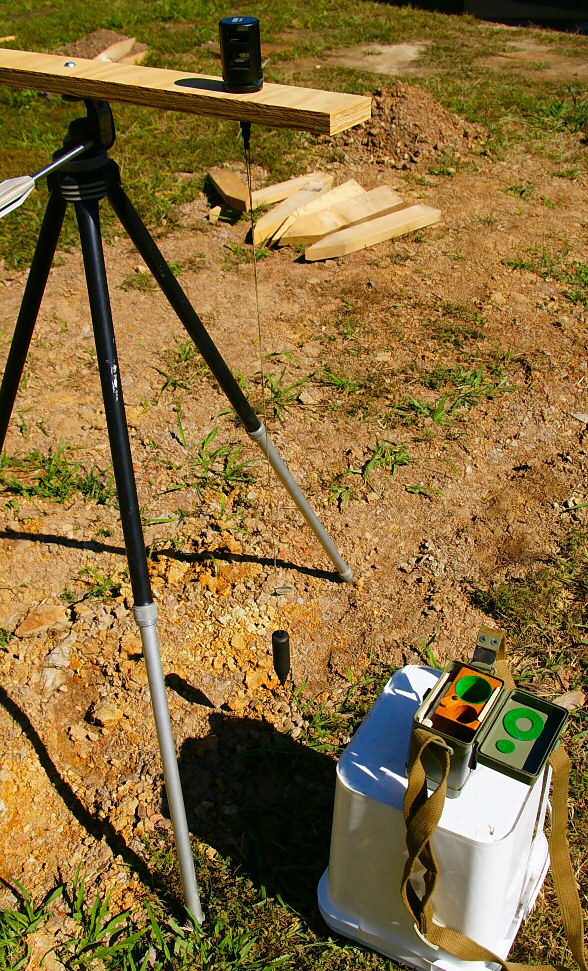
Looking into the main window gives three views. Or four, since one is split in two, though I don't yet understand all aspects of it.
The four components may be seen below. From the perspective of the camera, the top and third rectangles look ninety degrees left. I don't yet quite understand the utility in trying to find two elevations exactly 180 degrees from the Hranolovy, especially as the left hand split images do not include the horizontal hatch mark which is the distinguishing feature of the right hand view. The second rectangle looks ninety degrees right, and, in the picture, points directly at the north west corner of my barn, and shows (blurred in the photo, which suffers from lack of multiple focuses) the vertical and horizontal etch marks, with which to line up one's eyeball. The bottom rectangle is just an unobstructed straight shot through, and shows the compost bin seen outside the prism housing. The instructions seem to tout the straight through shot, but I don't understand why, as the view there is over a relatively wide angle, ie., not precise, at all.
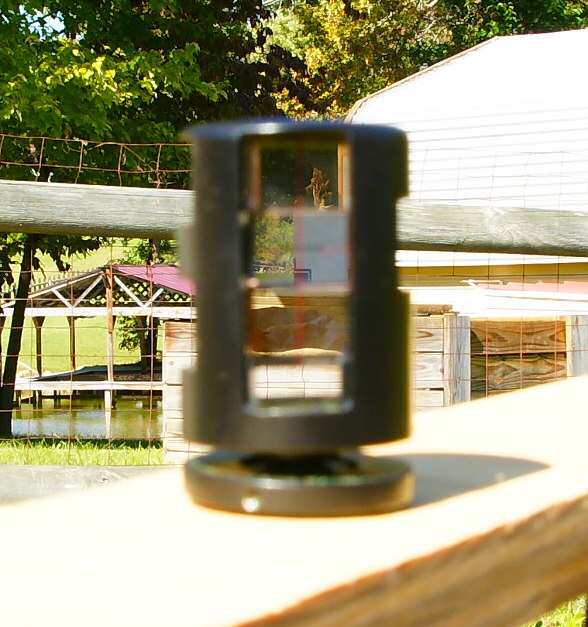
So! I took this thing, with the tripod setup, and put it twenty feet out from the mid point of the West wall of the barn. It was challenging through the the whole test, because the wind was blowing, moving the plumb bob around, swinging the prism housing to and fro. I had to estimate readings. First, I pointed the cross hatch rectangle at the right front (South West) corner of the barn, and through trial and error, kept marking spots on the housewrap until I thought the cross hairs were right on.
Then I rotated the prism housing, without moving the tripod, etc., until the same window pointed at the North West corner of the barn (above), and drew my marks, again by trial and error. The wind was blowing. I guestimated as best I could. And settled on a mark.
I then measured up from the bottom of the plywood sheathing (which was originally installed according to the concrete base, which was pretty much level), to the two marks I'd established with the Universalni Hranolovy Kriz. I was a little more than astounded when the measurement came up with a variance that I couldn't detect. I mean, it was perfect. With the wind blowing.
Compared to modern devices, it is slow and suspect. But I like it.
Thanks, Bro.
October 5, 2011
Bless him
My respect just shot up:
[D]espite being a $100-billion-a-year company in a rapidly changing industry, Apple never formed a political action committee.
Rest in Peace, man.
October 2, 2011
“I love my kids. Dead man was not my fault. Love, Dad.”
September 22, 2011
Refreshing
Quote of the week, via Techdirt:
With Eric Schmidt in DC today to be grilled by a Senate commission about antitrust issues, it's interesting to see that Rich Skrenta, the founder/CEO of an upstart competing search engine, Blekko, come right out and tell DC to keep its hands off Google:
We don’t need federal intervention to level the playing field with Google. Innovation and competition are far more powerful instruments to battle companies that have grown powerful and influential. Which has been more detrimental to Microsoft's business? The lawsuit brought by the Department of Justice in the 90s, or the innovative products Apple has brought to the marketplace?
The success of Google should be applauded on Capitol Hill, not derided.
Let’s let entrepreneurs, technology and good old-fashioned innovation deal with Google. Consumers will always be the winners in that scenario.
Fucking aye, Skrenta.
And Blekko doesn't look half bad, though DuckDuckGo — "We don't bubble or track you! See our privacy policy" — is where it's at on these searchable Internets.
June 14, 2011
Congratulations, Grace!
We were gone the weekend, up to Columbus, Ohio, to watch Grace matriculate, and there weren't a prouder bunch of people in the state.
Despite a very notable setback a year and a half ago that cost her an entire quarter, Grace graduated on time (though probably not under-budget) from Ohio State University, Bachelor o' Science, Summa Cum Laude with Honors!

There she is beaming at and being beamed at by the Dean of her college. She could hardly believe the last four years were gone.
Grace has a few weeks of slightly less arduous endeavors in store for her, and then she's off to Harvard, where she will surely likewise excel.
May 12, 2011
“Not Prince Hamlet”
Better than any novel (though just as long) , because it's all true and real, with a hundred protagonists. Like a play with actors entering and leaving, but far better than "Waiting for Godot" with more pointlessness and vapidity on one side pitted against soaring intelligence and sanity on the other, "A Good Day At The Monkey Cages". Equally despairing and uplifting, highlighting men's worst and best, and points between. Should be studied from junior high onward.
ps. The howling at Reason (Balko is out of town) goes on.
March 28, 2011
Heh
Billy Beck cites Mencken on anarchy at Instapundit. A link there to an earlier Reynolds post pre-tinues in similar vein.
Slightly later: As always, Venlet awoke an hour before I did. (p.s. Thanks for the link, John.)
February 5, 2011
Bifurcated breakfast
That'll wake you up in the morning: "How to Slice a Bagel into Two Linked Halves"
With easy to follow directions. Link via: Improbable Research.
All of which reminds me somewhat of carving chains out of solid wood, something I always thought I'd want to try, possibly at an advanced age.
February 2, 2011
Yum!
Lazy Magnolia's Southern Pecan Nut Brown Ale. Made with real pecans. Very lightly hopped, which is fine by me. One of the nicer new beers I've tried in the last several. (Beer selection, out here in the boonies, sucks.)
Drink up!
January 20, 2011
Walkin’ the dog through the ice storm
All day long I kept seeing people talking about the Governors Highway Safety Association report I blogged about this morning, and most of 'em were going on and on about every irrelevant thing in the story while ignoring the negligible 0.4% shift that underlay the whole thing. Countless phone calls were apparently made, statements taken, statements walked back, accusations of irresponsible reporting made, along with a call for more study by some idiot who really ought to know better.
Finally, Morrissey at HotAir does a decent job of it, without taking twelve paragraphs to do so, but then, the more interesting (to me) part is the completely unrelated story that makes up the larger, bottom half of his post, that perfectly juxtaposes the success of the private market with the failure of the public bureaucracy.
Apparently, a guy named Wattenberg took his toddler to the public school located across the street from the privately owned Sidwell Friends School, and found the sidewalks at the public school encrusted with ice. He looked across the street to Sidwell and saw that the sidewalks were as clean as could be.
Wattenberg must be paid by the word, as he wanders around describing the "shimmering, glacial sheet", ends up debating with himself "the better template", and who he's "not faulting", and almost blames himself, but does in the end beat it down to the old saw:
The Hearst ice illustrates anew an old problem with socializing responsibility: When everybody's responsible, nobody's responsible.
For the more concise version, with additional pith, see Morrissey.
January 6, 2011
Merry Christmas
New Paltz Journal II is back up, with a new look (most likely underwritten with some current software!)
Happy New Year!
ps. or maybe not.
pps. Yes, definitely. Eye popping. With the unerring slice of the national jugular thrown in.
And Beck breaks new ground with uncharacteristic understatement.
December 23, 2010
As anonymous as you want to be
Apropos of this morning's diatribe, a gizmo in the works that will automatically route all your home Internet traffic through Tor servers.
Looks like we can abolish the FTC, after all.
July 22, 2010
Gormenghast
Few have ever heard of Mervyn Peake or his tome describing the goings on in the great agéd castle named in the title, so it was a jolt to see a long piece on both by Jeff Riggenbach at Mises today.
I read that thing back in 1977, when I spent a year 100 miles north of Toronto, in a log cabin with no electricity or water – spending my time skiing, chopping wood, and reading – and it became one of my favorite books. For long years, though, I was unable to re-read the story, because the first time through had been a loaner, and the volumes were not available for sale in the United States. I searched high and low in book stores across the U.K. to no avail, also. As the Internet grew, I made periodic forays there, until I finally found a single volume version, now some years ago.
Peake's story is one of the strangest tales I've ever read, with the oddest conglomeration of characters ever tied together into a single convoluted plot. Parts of the thing are so densely descriptive that one might have trouble deciding whether to be bored out of one's skull at the plodding pace or admiring of the skill of the drawing, but one will wind up opting for the latter, for the characters are as ultimately unforgettable as they are indubitably unique. The names alone are a clue. Titus Groan, 77th Earl of Gormenghast. Lord Sepulchrave, his dad. The Countess Groan, with birds living in her hair. Fuchsia. Dr. Prunesquallor. Sourdust. Barquentine. Rottcodd. Steerpike. And many others. Later, there's Muzzlehatch and Juno.
I won't attempt a further review, and suggest that Riggenbach barely scratches the surface, but note that the tale grew out of that great turmoil that was World War II, which produced so many soul-searching ruminations, and that Gormenghast, obscure as it may be, deserves a place among the great works of the time (and henceforth, while we're at it.) The tale is strangely dark and equally strangely exhilarating. Like all good stories, it provokes thought. Read it, if you can find it.
June 24, 2010
Yang Youde
Susette Kelo could've used a couple of guys like Yang Youde:
A Chinese farmer is fighting off property developers who want his land, firing rockets from a homemade cannon made out of a wheelbarrow and pipes, state media said on Tuesday.
Yang Youde, who lives on the outskirts of the bustling city of Wuhan, in central Hubei province, said he had fended off two eviction attempts with his improvised weapon, which uses ammunition made from locally sold fireworks.
"I shot only over their heads to frighten them," he told the China Daily of his attacks on demolition workers sent to move him off his land. "I didn't want to cause any injuries."
[…]
Mr Yang said the local government had offered him 130,000 yuan (£13,000) for his fields, on which they want to erect "department buildings". He said the land is worth five times that amount.
[…]
A first eviction team attacked Mr Yang in February after his rockets ran out, but local police came to his rescue. In May he held off 100 people by firing from a makeshift watchtower.
You know, Yang Youde is down right inspirational.
Via: SondraK.
Gary Faulkner
The Bin Laden hunter. Video at Foolocracy. He's out there, but not in a bad way.
Hickory nuts
John Venlet is entirely too reasonable a man:
The city, at this point, is still determined to cut down this vigorous shagbark hickory, against my neighbor’s wishes, unless the neighbor provides the city with proof that the tree is healthy, as if its now fully leafed out branches are some sort of illusion. So I asked him, if the city cannot see for themselves that the tree is healthy and vigorous by looking at it in its current state of leafiness, what type of proof is the city requesting before they issue a reprieve?
I guess no one at "the city" has the balls to make a determination on his or her own recognizance. That's the sad sort of anti-intellect that has grown up out of subsuming oneself to the government. Such institutionalized ignorance is not benign, and will have long range repercussions.
To throw you the other way, also click along to Venlet's post on The Cactus Cuties.
June 19, 2010
Congratulations
To Warren Meyer, for snagging a weekly column at Forbes.
I've been waiting for Meyer to break into the Forbes 500 400, but I guess this is a good first step.
May 25, 2010
Zero scores a ten
Doc Zero finishes a resounding swat of collectivism, thusly:
There’s no problem we cannot solve, once we dismantle the failed State telling us it’s illegal to try. We can work together as free men and women, or depend on the State to loot individuals for the benefit of the collective, until they have nothing worth stealing. There are no other choices. There never were.
Read the whole thing.
May 20, 2010
LOL
Beck.