
October 29, 2009
Nice winch, plus: For the record
This was one of the days the year pivots around. We un-stepped the mast in ol’ Weave, the catboat. Since it was the first attempt ever (never even seen it done), the lead up was fraught with consideration and planning, while the actual act itself took about twenty seven seconds. Perhaps I over-prepared, but I had no way of knowing that the whole twenty five feet and nine inches of aluminum mast would weigh much less than a hundred pounds. Sweet Cheeks and I carried it easily after it was down.
But here’s how it goes, for future reference.
First, be sure to order a Dutton-Lainson Winch with Automatic Brake — 800-Lb. Capacity, because you’ll find many uses for it. Mine will float between mast steppings and the boat trailers. And it’s like magic. Crank it one way and it reels in. Let go and nothing happens. Crank it in reverse and your cable pays out. No balky levers, no rusty springs. Just crank it one way or tother.
Then figure out how to mount the winch to yer twenty four foot extension ladder. It took me about three hours to rig up a reusable base, but it was way overkill, and I’ll have to knock it down to something lighter and easier to mount. But I digress.
The dock: Screw heavy board to dock. Fix pulley to *top* rung of extension ladder using blue anchor chain and half inch rod through the clevises on either end of the chain. Walk extension ladder to vertical and bolt to board. Tie main lines to third rung of sliding extension. Tie side lines to top rung of base ladder. Set the pitch of the ladder and secure all lines.
The boat: All rigging that can be removed is removed. Boom, gaff, likewise. Bungie lazy jacks to mast. Mast hoops can hang, but might be secured, too. Loosen mast boot and raise it a little, and re-secure. Unscrew turnbuckle on mast forestay, bungie hanging forestay to mast. With line that will wind around winch drum, tie loose bowline around mast. Tie another line to that loop (use a bowline, again), leave twelve or more feet and tie another bowline to the bracket that holds the boom. Pull first bowline up the mast until lower line taught, then thread line through pulley and down the ladder. Send extension up to desired height. Adjust pitch and secure lines as needed.
Attach winch to ladder. Attach line to winch drum and take up slack.
Remove bolt from bottom of mast.
Knock out mast wedges, and hoist the mast clear, controlling lower end. Lower away, at leisure.
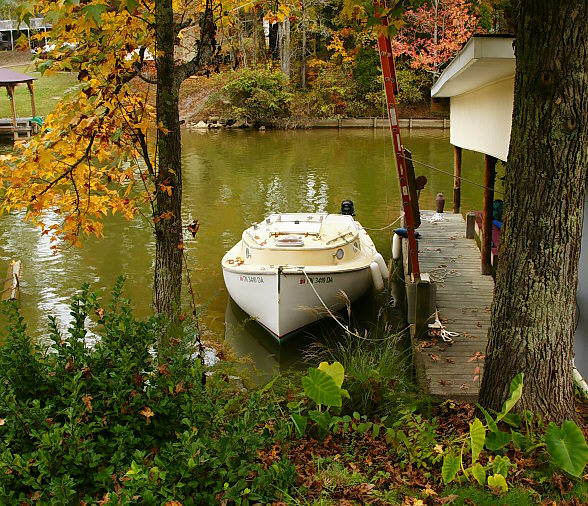
That’s it. And how do ya like our end of Rocktober foliage, eh?
September 6, 2009
Bon Voyage
There’s about a 120 mile hole in the storm systems, which ain’t nearly enough, but we’re going gunkholing, anyway.
Got a bucket of blood, some shrimp/ham/pineapple kebabs (pre-charred), rice, veggies, and a weather eye.
Pray the anchors hold.
The next day: Plans changed. The other parties to the party saw the big moving radar blobs headed this way and chickened out. We tried to sail up the lake anyway, but the wind died, and obnoxious people in motor boats kept circling us, causing us to rock and roll without music. We returned to home port and shared food and stories under lifting skies. There was the barest of rain sprinkles overnight. Forecasting is still a game of probabilities. Barrels of grog are always a sure thing.
August 8, 2009
Catboat!
We found another catboat on Watts Bar Lake. That makes us and them. We were over at Blue Springs Marina about a month ago, looking for some ballast for Weave, and in addition to some glib runaround (and no ballast), we were pointed to a new resident of E Dock:
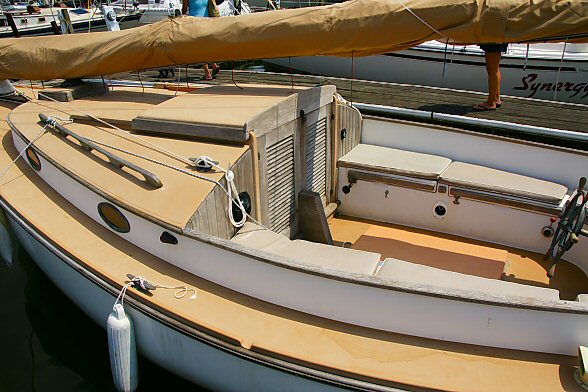
It looks to be a Marshall 22, one of the more popular brands (and sizes) of the catboat breed. At five feet longer than our catboat, it’s about three times the displacement, and probably pretty roomy below decks. It looks slightly neglected, but someone has invested in all new rigging. Apparently, it’s under new ownership, and was brought up from Florida in the bargain.
We’d love to see the thing out sailing, but we motored over to Blue Springs Marina again two nights ago and could tell that all the lines were tied exactly as they’d been a month ago. Additionally, the boat is now listing to starboard a little. I hope it’s just a little rain water, and not a leaky bottom.
Anyway, if that catboat ever heads out and gets tired of seeing nothing but skinny, boring sloops around, head on over toward Arrowhead Marina & Resort. We’re the first sailboat past there, on the right. If we’re not already out on the water, we can cast off in about ten minutes.
Relatedly, I recently stumbled across the following sorrowful lament about sailboats in general and catboats in particular. From Harper’s Magazine of 1877. Yep, a relevant article 132 years old. An excerpt:
There is one source of danger to which a catboat when running dead before a fresh breeze must necessarily be exposed. It is that of rolling the end of the boom under. A sloop, if the necessity occurs, can scud under her jib alone; but the catboat, having but one sail, must keep that set in all circumstances in which a sail is needed. Now when the boom is at right angles to the line of the keel, as it is when the wind is directly astern, the rolling of the boat is very apt to dip the boom into the water. When it is dipped to a certain depth, a capsize becomes inevitable. No seamanship can do away with this danger. It springs from the inherent viciousness of the cat rig, and no care or foresight can provide against it. Occasionally the boom, instead of rolling under, “kicks up,” as the phrase runs, and is wrapped close to the mast by the sail. The boatman, if he is a sailor, can usually extricate himself from a difficulty of this kind by one or another expedient; but if he is merely an awkward amateur, as is usually the case, he abandons himself to despair, and gloomily wonders where his body will be found, and whether it will be swollen to an unrecognizable extent.
The whole thing is hilarious like that.
December 19, 2008
Oh, yes they can!
The Instapundit guy links to a story about boat companies putting electric motors on some of their models, and then sez:
Not much luck on the regenerative-braking front, though, I’d imagine . . . .
Well, most boats don’t have brakes, it’s true, but a spinning propeller can be made to work both ways. Put one of the new electric motors on a sailboat, for instance, use it to putter out of port, shut it off, and then, while the wind becomes the engine, the freely spinning prop will recharge the batteries. See: Electric Yacht.
I think it’s just the thing for little Weave, but I’m going to wait until I see prices coming down on those babies, before I start drilling holes in her hull.
December 11, 2008
Voyage to the bottom of the sea
Not quite, but it was a tense few minutes.
Yesterday, the day dawned a beauty, sunny, a nice steady, slow breeze, and promises of temps in the sixties, with rain toward evening. In our usual unhurried style, we piled in the truck about noon, and drove around to the marina. It was almost balmy as we opened the boat, with a few high clouds seeming to melt in out of the blue, but the breeze was still steady and light. The tiny motor harumphed to life and we chugged straight out into the lake, and began yanking on the rigging a hundred yards out. There was a little trouble after I got the gaff up on the wrong side of the topping lift, but half a minute of playing around got it on the right side, and the big sail went up, up, up.
And then the breeze just died. We hadn’t sailed twenty feet. I fiddled with one or two lines, wondering if we were in for another day of the doldrums (the day after Thanksgiving was such a day.) And then the wind came intermittantly from different directions. Just little puffs, first one way, then nothing, than another puff from somewhere else, not even enough to move us. Just slowly, it got unnerving.
And then we heard it coming over the hill, through the woods behind the marina, howling. And it hit us, just that quick, like a ton of bricks, Sweet Cheeks at the tiller and hanging onto the main sheet, and me near the halyards. I yanked on the topping lift and the boom went up, but I knew it wouldn’t be enough, and didn’t bother to get it secured properly, but leapt to drop the peak and start the sail down. It was enough, but the wind still blew the hell out of us, and we had no idea how it might end. Sweet Cheeks had the tiller hard over, to get us pointed into the wind, but Weave was just blowing sideways, and the sail was reluctant to come more than halfway down.
I dropped the motor back in the water and it fired right up and gave us some headway, but the wind continued to play havoc with us. Even after I got the sail all the way down we were still being pushed around. But we were out of danger, and we motored back in, taking stock of ourselves.
Made a nice landing (our slip was out of the wind), had our cokes, and packed it up for the day, watching the whitecaps build, listening to trees snap (as in breaking) as the wind kept growing, and hearing other boaters exclaim over the sudden fury. Got home to find all sorts of cautions concerning the day’s weather, but it all came up out of nowhere.
Boats: you just never know, and always have to be watching.
October 30, 2008
No wonder we’re blown away!
We've been sailing the catboat for nearly four months now, and just learned something new.
From the start, we wondered what was up with the big sail. All the hints and tips we picked up online and in the thin The Catboat and How to Sail Her seemed to suggest that we wouldn't need to reef the sail until the wind went over twelve knots or so, but we were going out of control with the wind at around eight knots, which isn't a very heavy wind. We kept thinking maybe we were still just nervous sailing newbies, or that we couldn't tell wind speed from shinola.
Well, the other day I was searching around for pictures of other Wittholz catboats built by the Cape Cod Shipbuilding Company. There aren't very many such pictures, possibly owing to the fact that there are probably less than a hundred of these particular craft floating around in the real world. I could write the company and find out, but I've been lazy. Our boat, Weave, for instance, was one of only two built in 1976. Weave was boat #1 that year. Assume a similar production rate since the late fifties, early sixties, and you see what I mean.
Anyway, there's a small picture on the Cape Cod Shipbuilding Co.'s website, and there's another picture of a slightly newer version of our boat on flickr. Look at those tiny sails! It started to dawn on me: Weave came with an extra large sail, somehow. Look at the thing, below.
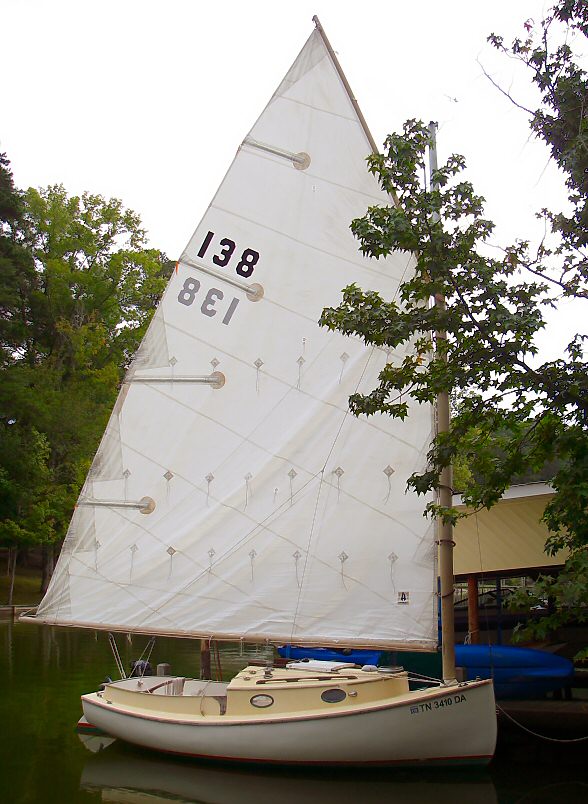
I started looking at the online pictures a little more closely. Hmmm. The booms on the other CCCatboats didn't seem to stick out over the stern as far as Weave's. There is no way to stand on Weave's stern and reach the end of the boom. If I have to fiddle with something there, I have to do it from the dock.
So I went looking for the specs. The builder's website has a spare parts list and the boom (available as of last year for a paltry $522.00) is listed as being eighteen feet long. The upper spar, or gaff, is supposed to be fifteen.
I flew down to the dock with a tape measure and what do you know? Our boom is twenty one feet long, and the gaff is where it should be, at fifteen.
We figure that the previous owner plus one, up Baltimore way, was into racing catboats, and rigged the boat for extra power. The sail is from a Baltimore area sailmaker.
Well, well, well. It's a good thing I didn't run out and order a new sail for the thing, or I would have been mighty perplexed upon trying to hang it.
Naturally, I wondered just how much extra sail Weave is flaunting. The standard design is said to be 250 sq. ft. Using my exhaustive knowledge of geometry, it took me about an hour with a pen and scratch pad to remember that all triangles with the same size base and the same height contain the same area. The extra three feet of boom, with the sail height guessed as being near twenty eight feet, meant extra canvas of approximately forty two square feet, with a few feet more in the big arching outside curve of the leech, known as the roach. All in all, it looks like Weave is carrying about 20% more sail than she was born with.
There's nothing at all wrong with having all that canvas, of course, but it sure does explain why we were experiencing the things we were, out there on the water. It explains having to reef the sail at lower wind speeds than we expected, and it tells us that the weather helm we fight may be more pronounced than in similar catboats with a smaller spread.
All in all, quite interesting.
October 12, 2008
The best investment I ever made
Weave, the catboat. Bought her a little more than three months ago, and she’s been nothing but a blast ever since. Yeah, she’s a little dirty in the picture below, on account of the leaves falling outta the trees over her berth, but we’re as proud of her as punch.
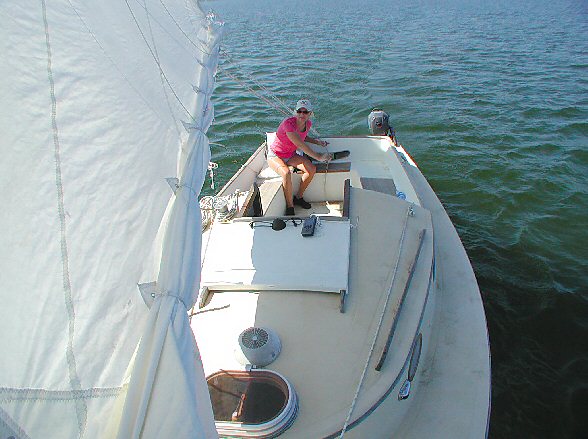
We motored out, yesterday, into a picture perfect day (almost ninety degrees, deep blue sky, no clouds) to find the wind just a little stronger than we’d guessed it would be from our sheltered finger of the lake. The full sail is something like 245 square feet, which is a lot of sail for a seventeen foot boat, but it’s got three rows of reef points built in to facilitate shortening it up. We started out tying in the first reef, but before we had it done realized that the wind was too strong still, and so we dropped the sail another three feet, tightened the reef tack, pulled the new clew taut, and tied the reef points along the boom.
It was our first two reef day, and Weave sailed like a dream. Catboats are notorious for their weather helm, and she is no exception. With a moderate wind and full sail, or a heavier wind with one reef in, she wants to turn to windward, which makes for a good workout on the tiller when she’s really moving. But, with the second reef in, the Center of Effort (a point on the sail) moved forward with respect to the boat, closer to or nearly above the Center of Lateral Resistance (a point on the hull), and the weather helm all but disappeared, leaving the boat almost perfectly balanced, even when heeled over and chugging along. And the smaller sail was definitely less "twitchy", effectively giving a stiffer ride through yesterday’s highly variable gusts.
We zig zagged out about five miles, farther than we’d made it before under sail, almost to Blue Springs Marina, before the wind started to slack off a little.
Just before we turned for home, Sweet Cheeks caught the biggest fish of her life, a nice bass maybe fourteen inches long.
Coming back we let one reef out, for about a mile, and then, as the wind fell even more, let the full sail loose for the last two miles, and glided back home at a nice gentle clip.
Invest in a catboat. You won’t regret it.