
December 15, 2016
Sailing Precious Snowflakes
They call themselves anarchists, so maybe they are not all that bright, but I read Sailing Anarchy almost every day because they are amateur but active, and because I like the call of the sea, and the sport and spectacle of sailing, especially in its modern form. I love the America’s Cup (which SA ostensibly doesn’t), as imbued with corporate mass marketing as it is, and as fraught with high stakes corruption and nonsense as it is (remembering fondly how people were saints in olden times), but any regatta and race has the potential for greatness, just as every sailor, “setting and hauling” over the ages, attempting to master wind and wave, is one of the original and enduring archetypes forging on against a world unknown by, at least, landlubbers.
I take “anarchy” for “insouciance,” I guess, and enjoy the raw take.
But crap is crap, and this is crap, in a post officially announcing the U.S.A.’s first offshore wind farm in the Sound just outside Rhode Island:
You’ll be happy to know that the Orange Hitler is “personally offended” by “awful” wind turbines. He surely would have killed this project as he hates renewable energy sources. If Exxon and Putin aren’t going to profit from it, Hitler isn’t interested. This son of a bitch is going to destroy the planet, likely in a number of ways. All you Trumpanzees must be so proud. – ed.
The first link in the indented section just above goes to a Daily Caller item from just a few weeks ago wherein Trump also says…
“[W]hen I look out of my window [in Scotland] and I see these windmills, it offends me. You’ve got to do something about these windmills. Let’s put them offshore, why spoil the beautiful countryside?’”
Ha ha. Did Hitler say, “Let’s put them offshore” in an article that asserts Hitler would kill offshore wind farms? Ha ha.
And just who HAS opposed those wind farms off the southern New England coast? Most of the Kennedy family, with a few coming to their senses. John “Fromage” Kerry. Walter Cronkite. Mitt Romney. Those nasty elitist white bastards. None of them being D. Trump. (Noting that Prez Elect Trump has declined to bring RINO Romney into his administration.)
Also noting: The Kennedys, Kerry, and Cronkite all being avid sailors in their time, but, I guess, not being Sailing Anarchists!
In the Second link of the quoted section above, the link saying Trump, “hates renewable energy sources”, Trump is quoted as saying he hates wind power because:
“The wind kills all your birds. All your birds, killed. You know, the environmentalists never talk about that.”
What Trump didn’t mention is that those giant spinning towers tend to kill the bigger, already endangered birds, like Eagles and Hawks. English Sparrows and Starlings, not so much.
The Solar Reflective Arrays get the smaller birds!!! Fries ’em good.
But it’s okay, because cats kill a lot of birds.
Which is a far spiel from sailing. Especially high tech, modern Anarchy style sailing. Where privileged white guys and gals on very expensive boats attempt to hang with very much more privileged white people on very much more expensive boats in exclusive venues in far off exotic locales, all those racing boats sporting their corporate or government sponsorships. And (not much mentioned) requiring their government rescues when those long deep, high tech keels, carbon fiber foils, and very expensive tillers hit those unidentified but probably organic obstructions in the middle of the sea in the middle of the night.
Bitching about Orange Hitler Trump.
It takes all kinds, I guess.
February 19, 2014
Tilt Tilt Tilt
Another way (Vimeo) to take your too tall sailboat under that dang bridge.
Via: Sailing Anarchy.
The other way, previously.
Of course, there are other ways.
November 27, 2013
Winging It — America’s Cup 2013
I'm not as big a watcher of sports as I was back in my youth. Seems to me, after one has seen more than two dozen football teams go at it for umpteen years, after one pitcher after another has pitched 100 mph balls down toward the little box a hundred thousand times, after Shaq, after tennis has become so fast as to be incomprehensible, with all the announcers and fans blowing noise like every announcer and fan blowing the same noise over the years, it's just watching the same show over and over.
For the last months, I've been watching the recent America's Cup over and over. The play-by-play announcers make me cringe as they do in any sport, and moreso with the repetition, but the singular nature of the latest decidedly singular version of the historical boat race is in a class by itself. For all intents, AC-72s are a new sport, and one that might never be seen again. At the same time, it's but one more iteration of a sport that goes back eons. People have raced sailboats since the dawn of boating, but nobody has ever raced carbon wing foiling 72 ft catamarans at 30, 40, and 50 miles per hour before.
And nobody ever raced sailboats over 19 races with the kind of poise and sportsmanship that New Zealand and Oracle evinced. If you pour over the videos, the multi-view, un-censored proceedings on both boats, the between race interviews, and the after race press conferences, there is never a hint of anything other than honest sportsmanship and genuine accolades to team effort. When, at one point, Oracle's boat fell off its foils, some crew member exclaimed, "Shit!", and a couple of other times someone cautioned, "We're on TV", but that's as risque as America's Cup racing jocks are, it seems.
And never let it be said that sailing the AC-72s is easy. The boats are 72 feet long, 45 five feet wide, and 130+ feet tall. They make speeds over the water faster than most engined boats in the world are capable of. The practical physics are astounding. With a wind of 18 knots from behind the crews feel a wind of 20 to 30 knots from the front. They are sailing upwind even when they are sailing downwind. Sailing upwind, they consistently achieve speeds 50% greater than the wind they're sailing into. All with intermittent spray blasting their faces. Anyone who's ever ridden a motorcycle in the rain will know the punishment of it.
For your further enjoyment, the race is enhanced by state of the art video and audio. The NFL has its first down lines, etc., but the 2013 America's Cup has computer-generated course grid lines, boat tracks, laylines, boundary lines, tidal current graphics, wind wash, other graphics, and audio. Add in the LiveLine, computerized, sailing animations (which accurately render such things as NZ's near capsize in race 8 and the penalties in race 17), the multiple on board cameras, the camera work from a couple of shadowing helicopters, and microphones recording team conversations, and it's a pretty comprehensive and expansive spectacle.
And there it is: two groups of 11 men, blasting their way around beautiful San Francisco Bay, skirting back and forth past Alcatraz, in large, expensive, somewhat fragile, fast moving boats, over the course of more than two weeks, exhibiting the best of sportsmanship, brought to your face with some impressive technology.
And the competition. New Zealand was overwhelmingly ahead through the first half of the competition. They really couldn't lose. Oracle had to win the last eight races, the loss of any of which would have meant a New Zealand win. Every single race was important. And then Oracle won those eight races in a row.
Even when you know how every race goes, it's still enthralling. At least to me.
Below are my own notes on the entire race. Elsewise, Wikipedia has an alternate version.
September 7, 2013
Race 1: New Zealand with start box rights. New Zealand across line first, bests Oracle to first mark by four seconds. Oracle followed around bottom mark four seconds behind NZ, forces NZ tack, but can't take lead. Oracle wins first upwind cross, closer on second. Keeps lead on third cross. NZ takes it back on fourth. A poor tactical decision, arbitrary wind, and slow tacks leaves OR 25 seconds behind at top mark. 34 seconds at bottom, 36 at finish. 15-16 knots o' breeze. Both teams call protests on the other at various points, but none granted.
Race 2: Wind 17-18 knots. OR in box first. OR tried a hook short of the start line but missed. NZ over line first, and to the first mark by two seconds. OR 7 seconds behind at bottom, and dives the hulls. 46 seconds behind after upwind leg. 51 seconds at last mark, 52 at finish. NZ dominated all the way around.
September 8, 2013
Race 3: Wind around 16 knots. OR start box favors. NZ over first. OR wins to leeward and pushes NZ away from Mark 1 and leads by three seconds, penalty to NZ (unclear why.) Split at the bottom with NZ 18 seconds behind. NZ eats away upwind, and then wins tacking battle in middle of leg. OR slower onward to top mark, where they lag by 29 seconds. No gain for OR on downwind, 28 seconds behind at finish.
Race 4: NZ has first entry rights to start box. Nearly even over line, but OR pushes NZ away from first mark and leads there by 2 seconds. OR opens up downwind after NZ bounces around just a little. OR falls off daggerboards nearing bottom mark allowing NZ to follow only 5 seconds behind. Wind blowing 22 knots allows OR to gain lead upwind. NZ 16 seconds behind at top, 5 seconds at the bottom, 8 seconds at finish. First win for OR.
September 9, 2013 — Day Off.
September 10, 2013
Race 5: Wind 18 knots. NZ start rights. OR rounds outside NZ after the start and hits the first mark 4 seconds ahead, after fouling NZ's air. NZ trails at the bottom mark by 8 seconds, but OR blows an ill-advised foiling tack they didn't need. OR wins first cross but only with starboard rights. NZ then runs away on upwind leg number 3, with OR insisting on fighting the right side current for some time. OR sloppily tacking rounds mark 3, 1:17 behind. 1:14 behind at last mark, 1:05 at finish.
Race 6: OR plays their one provisional card and postpones race.
September 11, 2013 — Day Off.
OR tactician J Kostecki is out and Sir Ben Ainslie is in for the rest of the regatta.
September 12, 2013
Race 6: Wind 12 knots. OR rights. OR takes start handily and rounds Mark 1 nine seconds ahead, but follows with some loose jibes. A 12 second split at the bottom. NZ wins the first cross upwind forcing OR to dip. OR takes second cross forcing NZ to dip. NZ dials down on third cross forcing OR to take a deep dip, and that's all she wrote. OR loses on every tack upwind, 44 seconds behind at top mark. 42 seconds at bottom, 47 at end.
Race 7: OR starting rights. Wind 16 -20 knots. NZ over line first with speed. OR 2 seconds behind at first Mark. OR 7 seconds behind at bottom. And that's it. OR tactical mistake heading back toward Alcatraz. 56 seconds behind at the top. 1:06 behind at finish.
September 13, 2013 — Day Off.
September 14, 2013
Race 8: OR comes out without its bowsprit, removing excess weight and windage. Wind 19 knots. NZ entry, and then nails the start, leading OR by 3 seconds at Mark 1. OR splits the course at the bottom mark 8 seconds behind. NZ wins first upwind cross, but OR is in better wind to the left of the course and slowly eats the NZ lead. Much close maneuvering. AND THEN NZ ALMOST FLIPS THE BOAT! NZ shaken for the rest of the race. OR takes the upwind mark with 28 seconds to spare. 48 seconds at the bottom, 52 at the end.
Race 9: Winds 20+ knots. NZ first in box. NZ takes start, rounds first Mark 4 seconds ahead. After a drag race OR splits at the bottom and 8 seconds behind NZ. And then the race is called on account of excessive wind, as stipulated by controversial rules that both teams agreed to long ago. No winner.
September 15, 2013
Race 9: Wind 18 knots. Oracle first in box. OR pushes NZ into the wind at start, takes first Mark by 4 seconds. OR slowly increases lead downwind. NZ splits the course at 18 seconds behind. OR leads by 33 seconds at top. 47 seconds at bottom and the end. Clean win for OR, all the way around.
Race 10: Wind 17 knots (start delayed by higher breezes). NZ box honors. Close start, but NZ won the first Mark by a few seconds. OR splits at the bottom with a lousy turn, eleven seconds behind NZ. OR wins a late cross and then is forced to dip on the next, but wins the cross just before the top, where it was almost dead even. OR makes unnecessary dip going downwind. NZ has the better wind and takes it home. NZ ahead by 11 seconds at the last turn, and 17 seconds at the finish.
September 16, 2013 — Day Off.
September 17, 2013 — Both races postponed for high winds.
September 18, 2013
Race 11: Wind 16 -18 knots. NZ box honors. NZ takes the line at slow speed, but almost parks OR, and wins the first Mark by three seconds. OR splits at the bottom, behind by 6 seconds. Dueling tacks going upwind but NZ makes no mistakes and leads at Mark 3 by 17 seconds. Much closer at the bottom mark with both boats having to slow to inch up to the mark, but NZ takes it with a 18 second lead, with 15 seconds at the end. With the Race 11 win, New Zealand needs only one more to take the cup, but won't manage it in any of the remaining eight races.
Race 12: Wind 17.5 knots. OR into the box first. Race postponed to excessive wind seconds before the boats hit the start line, but not announced before NZ left OR at the start and headed for the first Mark with a big lead. No winner.
September 19, 2013
Race 12: Wind near 17 knots. OR has start box, throws a big hook before the line forcing NZ away, and leads by six seconds at the Mark. NZ behind 11 seconds at the split at Mark 2. OR shows upwind speed and better tactics, though NZ is only 10 seconds behind at the top. 29 seconds at the bottom, and 31 seconds at the finish.
Race 13: OR with honors to start. Postponed for high wind with both boats in the start box.
September 20, 2013
Race 13 again: Lightest winds of the race at 9 – 12 knots. Fog. Delay to realign the entry buoys to compensate for southerly breeze. NZ has start rights. Both boats with their gennakers up but furled. OR wins the start, both boats slow, OR holds NZ off the first mark and then turns, both boats deploying gennakers. OR leads by 10 seconds at Mark 1 after a very slow run. The boats are essentially traditional catamarans, no foiling. NZ starts walking away. It becomes obvious that the race won't be completed in the alloted 40 minutes. OR rounds the bottom mark (lines trailing off the stern, two people subsequently working to undo a large snarl, and OR not being able to deploy their gennaker later) 1:42 behind NZ. OR rounds Mark 3 at 2:27 behind. Just as NZ prepared to round the last mark, the race is called for exceeding the 40 minute limit. No winner.
Race 13 again again: Wind at 11.5 knots and building. The boats are foiling. NZ has entry rights, and blocks OR to win the start and Mark 1 by 3 seconds. NZ creeps away downwind for a while, but OR creeps back and bonks a foul on NZ on a right hand cross. It is the only downwind pass of the series. OR makes a masterful move at Mark 2 and slows NZ to a crawl and a 12 second deficit at the turn. Spithill's aggressive moves win the race. NZ 46 seconds behind at the top of the upwind leg. Wind under 9 knots toward the bottom mark? OR still foiling. NZ straggles in at 1:24 behind.
September 21, 2013 — Racing postponed because the wind coming from the South made the set course untenable.
September 22, 2013
Race 14: OR start honors. Over the line even, with OR to leeward. OR pushes NZ to the boundary and wins the first Mark by 6 seconds. It's all over. NZ 24 seconds behind at the bottom. NZ was creeping up below Alcatraz, but made an extra short tack that set them back. NZ behind by 15 seconds at the third Mark. OR has a slow jibe going downwind, but NZ almost on their stern, also chooses to jibe, and ends up sailing away from the Mark. Neither boat foiling heading to the bottom mark. The wind comes back at the bottom, with OR winning the bottom Mark by 24 seconds, and 23 seconds at the end.
Race 15: Winds building around 15 knots. OR starts first. NZ looks good over the line but rounds the first Mark 3 seconds behind. OR rips it on the down leg, leaving NZ 1:00 behind at the bottom. 11 knots wind going up, but more coming in from under the big bridge. OR foiling upwind while NZ drags, yet only 32 seconds behind at the top turn. 37 seconds at the bottom and the end.
September 23, 2013
Race 16: Winds too low to start on time, and race delayed by 30 minutes. Skip to about 41:50 for the start. Winds are still light, at 10 knots and a little higher, and both boats are set up for gennakers. NZ has entry rights. Even start, but OR pulls in front to the first mark, leading by five seconds. NZ deploys their gennaker first but it doesn't really help. OR deploys theirs halfway down the course, but it doesn't make much difference, except that playing with it near the bottom mark probably hurts. The sailing seems almost lazy compared to breezier days. NZ splits toward the bottom, and OR rounds the mark 13 seconds ahead. Gap remains steady going upwind. OR makes an extra tack at the top, leading by 19 seconds, to head off shore and open up their lead. OR has smooth sailing as the wind builds a little. 21 seconds at the last mark, 33 at the end.
No time for a second race.
September 24, 2013
Race 17: Wind 17 knots or so. OR granted first entry to start box. Spithill plays it masterfully, pulling a last second hook on NZ, forcing them into irons and two penalties when both boats drift sideways across the line, with the wind eventually blowing the NZ boat up against OR. (Virtual Eye segment of the contest at 48:52, and a glimpse of the slight damage to NZ at 50:07) OR takes off and beats NZ to the first mark by 17 seconds. NZ behind a whole 29 seconds at the bottom. Wind close to 20 knots. OR flies upwind, but NZ does, too, and finishes the leg only 19 seconds behind. Wind at about 18 knots, boats breaking 40 knots downwind. NZ 17 seconds behind at the 4th mark, and 27 behind at the end.
Race 18: NZ start box rights. NZ gets an overlap by inches and then loses it, with OR avoiding a penalty and winning the start line, but being pushed away at the first mark, ending up 5 seconds behind. Looks bad for OR. Both boats at over 40 knots downwind. OR sets up for a split at the bottom, turning up 7 seconds behind. Instead of crossing after the first tack, NZ turns too soon in front of OR and instead of blocking, allows them by. Both tack at the boundary with OR in the lead. Then NZ throws in another ill-advised tack, and never manages to come back. Bad tactics by NZ. OR at the top by 57 seconds with NZ falling apart. OR leads downwind by over half a mile. NZ 49 seconds behind at the 4th mark, 54 seconds at the finish. It's all tied up, with one race to go.
September 25, 2013
Race 19: Winds nice at 18 knots. NZ has first entry to the start box. Neither boat gets too contentious and OR takes the windward position. Even start with a race to the first mark, where OR falls off their foils and buries both hulls and loses the mark by 7 seconds. But OR jibes first and drag races NZ down the course, hanging 40 some yards behind, hitting 40 knots. OR just feet behind after another jibe. OR just 3 seconds behind as they make a nice last second split at the 2nd mark. OR creeps into the lead, but loses at the first cross. NZ goes too far toward the shore and light wind and loses the next cross. OR wins the next cross, demonstrating better speed on both tacks. OR wins the next cross, and opens up their lead. Captain Spithill flogs the crew. OR's lead continues to grow, with NZ 26 seconds behind at the top. OR has time to play it conservative heading to the last mark, rounding 39 seconds ahead of NZ, and then winning The Cup by 44 seconds at the end.
Magnificent all the way.
September 26, 2013
On a wing and a couple foils
They did it. Oracle turned the Kiwis into little green fruits. The greatest comeback of all time.
You can hear the winning teamwork of the Oracle crew kicked up several notches in the race today. Constantly talking. Only dim echoes of slave boats of centuries past. We've come a long way.
Usually I say this kind of thing sarcastically, but truly I feel Dean Barker's pain. He skippered nineteen plus races nearly flawlessly. He was in it heart and soul, never (as far as I know) marked his early big lead as a sure thing, and watched from his prime spot as all his and his team's efforts came to naught. Or not naught, but something less than might have been. Barker was a worthy opponent to the end.
Oracle won on The Rules. Had it been something less than a best of seventeen race, Oracle would have lost. Had the wind limit Rules been set to something higher than 23 knots (set for arguable safety reasons), Oracle would have lost. Had races not been limited by The Rules to 40 minutes, Oracle would have lost (in the one really low wind day of the match).
As everyone agreed to everything before hand, that's the way it goes. At one point, reportedly, Oracle reached out to Emerites to change the wind limit rules, but was rebuffed. Of course, after that, the wind limit wasn't a factor, that I recall.
I don't know what will happen to these marvelous AC72 boats after today. They may not be quite the thing on which to scoot around Watts Bar Lake, even if one could find the crew. And my dock isn't long enough.
September 25, 2013
18 races and all even
USA has won seven in a row to punk the hell out of New Zealand to bring it all down to the final race of the America's Cup. For all the last seven races, New Zealand needed to win just one to end it, and didn't manage. The freaking Rules of the match inflicted the New Zealanders three times (resulting in cancelled races) when they had the advantage or were clear to win, but there are no contentions that the Rules were applied unfairly. The freaking Rules also saddled USA with a two race deficit from the start for cheating infractions in a Pre-America's Cup regatta (there may still be some contention there), meaning that for today's tally the USA has won ten races to New Zealand's eight.
In some respects, sailboat racing is a pretty nasty sport. There are numerous (normal sailing) rules governing which boat has the right of way in different situations and the boat with the right of way while racing can be ruthless in asserting itself, driving the other boat into stalls or out of otherwise favorable courses or eliciting penalties. The USA has forced and won the majority of such contentions. Races 17 and 18 today were no exception. In 17, USA forced New Zealand into irons, whereupon they drifted down into the USA boat (denting themselves) incurring a penalty.
The last race is tomorrow, Wednesday, weather permitting. If the wind is above 15 knots, I predict a USA win, otherwise a toss up. If you can stay away from the evening news like Sweet Cheeks and I do, you can catch the action on YouTube a couple of hours after it actually goes down (which is about 1:15 Pacific Time, barring difficulties).
One of the things I've liked about this contest is the sportsmanship of both teams. There have been absolutely no recriminations about the two race deficit imposed on the USA team, or about the Rules parameters that have adversely affected New Zealand. The two crews just want to race according to the rules of sailing and the contest and they'll do it with whatever they're given. The only time I've seen a crew demoralized is after the second race today with the New Zealand team decidedly glum after losing seven in a row and facing their greatest challenge tomorrow.
It's all fabulous nonsense, I know. The boats are routinely referred to as hundred million dollar boats, and they probably are. Whether that is just for the hardware of the boats, or includes the crews (on boat, and the probably larger shore crew), which aren't free, I don't know. Add in the usurpation of San Francisco Bay for more than two weeks (some costs apportioned to San Fran taxpayers) with all the support boats and videoing helicopters (up to three, I believe), and it is definitely a 1% spectacle. The benefactors, the crews, are all one percenters. Yeah, they cheaped out on the commenters, but the video and stats the commenters have to work with are state of the art. On board multiple camera angles with live onboard crew discussions are amazing.
Beautiful.
September 21, 2013
The sun is not yet over the yardarm
Except that it's always eleven thirty somewhere, and I'm happy to report that the Vodka therapy my doctor didn't prescribe is making for relatively smooth sailing on these waters. I could be back to blasting logs to splinters tomorrow.
Miraculously, Team Oracle is still alive after Race 13, though they owe it all to the nefarious Rules. At least three races were scrubbed because the winds were too high, in each case with New Zealand looking to have the advantage. And then, today, with New Zealand ahead by a mile, The Rules kicked in again with the leader not able to complete the course in under the alloted forty minutes. In the following re-race, with slightly heavier winds, Oracle took it home to stay alive. Pins and needles, and Sweet Cheeks says she's rooting for the Kiwis.
The America's Cup commentators still suck. At one point we heard one of them say that he didn't know much about sailing. Enh. Do tell.
In the first race today, the one called for time, WE noticed (the commentators didn't) lines flopping in the water astern of the Oracle boat (YouTube at after 36:00). Gadzooks, what sloppiness, and potentially disastrous. Subsequently, the Oracle crew was shown to be attempting to straighten some (coincidentally?) massive fouling of lines that probably controlled their gennaker, which they seemed unable to deploy as New Zealand practically sailed over the horizon. Horrible, horrible. But The Rules absolved.
Two more races are scheduled for tomorrow (Saturday) unless New Zealand wins the first one. The tiny islanders still only need to win ONE, while the stalwart proxies for American derring do need to reel in SIX in a row, though team owner Ellison seems to have lobbied King Neptune heavily in the tried and true corporate fascist manner.
See the races on YouTube (delayed by an hour or two or three, depending.)
September 19, 2013
Winkin’, Blinkin’, and Drinkin’
After much hands on research, I have concluded that Vodka beats Gin and Bourbon for smoothing the spasming of muscles in my lower back.
Even after using the ol' back in chain sawing and hauling (I've picked up each tree at least twice, so far) seven or so oak trees home for future Winter heating, and even after beginning the splitting (I picked them up again) of said trees, or maybe because of, I was up on the roof the other day putting vinyl siding on the new faux chimney when something went *SPROING*, the adrenaline rushed, I dropped my tool belt and gingerly climbed down, and have been rueing my infirmities ever since. (I did subsequently finish the chimney, but not with alacrity.)
However, thanks to Vodka, tomorrow I shall be whole again.
Elsewherelike, my blog about the America's Cup (the Kiwis could wrap it up tomorrow after various global warming interferences) may have caught the attention of the Sailing Anarchy folks that I linked to, who, decrying the lack of media spectacle wrote:
ac media blitz
Oh wait, there isn’t one. Save for the occasional “lamestream media” article, the usual fawning from the sailing glossies and a couple of fat, lazy and desperate rip-off bloggers, the sport that nobody cares about once again careens off the screen where it was barely even a blip, and along the way suffers another a blow at the hands of the super rich egocentric elitists and the whores who do their bidding.
I want to know who the other fat, lazy and desperate rip-off blogger is!
I mean, I'm a sailor, man, and possibly an anarchist (as long as I don't have to share a donated sleeping bag), and I don't think I'm ripping anybody off, so where's the love?
September 17, 2013
By the sea, by the beautiful sea
Two tales of wandering barks…
Over the last week or so, we've been intermittently glued to YouTube watching Oracle and New Zealand duke it out in the America's Cup on San Francisco Bay. The race is fairly lopsided, New Zealand has just about clinched it (if they win the two races tomorrow/today, it will be over), and the Oracle crew may not be the best example of our much recently maligned American Exceptionalism (some of the crew may not be Americans, if that matters), but those boats. Those boats. They sail like nothing else has ever sailed. Even the hiply jaded folks at Sailing Anarchy can't help but be enthralled with the spectacle. (See this for minimalist sail-foiling. [or even foil-sailing — ed.])
Three years ago, BMW Oracle won the America's Cup off Spain in a lopsided two of three outing in (then) high tech trimarans which always sailed with at least one hull in the water. Setting the rules for a 2013 contest in catamarans, Oracle and the rest were blindsided by the New Zealand upstarts who were caught with both hulls out of the water in September 2012. That's how new the tech is, and if you watch the current round of races of the last ten days, you'll understand that everyone is still learning.
Viddy the whole series here, wonder why anyone would choose a best of seventeen format, ignore for the most part the horrible commentators (be prepared to look up everything they don't explain), and marvel at not only the beauty of the boats that sail two to three times faster than the wind, but the professionalism of the sailors, and just as impressively, the video tech that makes the viewing possible.
If you want to skip some of the blah blah blah, the races tend to start on the twelfth or thirteenth hourly minute marks of the videos.
__
Elsewhere, as a big fan of parbuckling (though I didn't know it was called that until today), I spent a little too much time today watching lead salvager, Florida-based Titan Salvage (receiving no credit from the New York Times), working with Italian partner Micoperi (getting more credit, but not as much as the official Italian government nitwits) slowly rotate the crashed Costa Concordia, all in one piece, off the granite sea bed and onto a stalwartly constructed and intrepidly installed undersea platform. The process took nineteen hours, and was an apparent exceedingly successful success. Partial time lapse video here.
A moron writing for BloombergBusinessweek didn't mention Titan or Micoperi, did mention Italy's mucks, but also injected his own ignorance into the story…
Shortly before midnight, the Concordia was raised by 25 degrees — after that, engineers said, the effect of gravity started giving the rotation a boost.
Then engineers quit operating the pulleys, and by using remote controls, carefully began opening valves to let seawater start filling huge ballast tanks that had been welded onto the already exposed side. The weight of the water in the tanks helped pull the cruise liner up much faster.
Not quite. After the ship was cranked up to a certain point, the "huge ballast tanks", or sponsons (that word brings back memories of one of the more intransigent spammers of a set of kayaking Usenet groups in the early aughts), filled with air at that point, kept the ship from rotating too quickly (ie., dangerously) onto the target platform. Allowing seawater to enter the sponsons did NOT add weight, as the writer says, but merely removed buoyancy, allowing the ship to settle in a controlled manner.
It looks to me, despite official pronouncements, that the Concordia settled a tad beyond the 0 degrees target inclination, though it could be a factor of camera angles, but also might reflect an engineering miscalculation, or even a non-miscalculation that gives slightly better access to the side of the tub that little has been seen of in the last year plus, and which will require much work.
All in all, nice work.
September 22, 2011
The good ship Eileen
Dandy video of a ketch with an 80 foot mast motoring under a 65 foot bridge.
I was wondering how they knew they were leaned over far enough, but it would be easy if they knew the length of the line paid out plus the height of the water bags. Mark the line at 60 feet, and when the bag hits the water, it's good to go. Though really, you don't even need to know the length of your lines or the height of the bag. You just need to know by how much the mast is too tall. Hike the ball bag that much above the water, over the mid-section of the boat, and that's your measure.
July 11, 2011
Arise. ARISE!
Anyone remember the sunken sailboat I blogged about more than two years ago? It was in a slough about a mile and a half from here.
More than a year ago, I was out in the kayak, noticed the boat had been raised, paddled closer, found the owner and his wife sitting in the cockpit, and exchanged pleasantries with them. They were going to refurbish and possibly be seen sailing again, eventually.
Well, their house, sitting on the hill above the sailboat, burned to the ground shortly thereafter. And then, somehow, over Winter, the boat went over again. And there it sat, all this year.
Two nights ago, Jay asks, "Can you help me tomorrow? This guy says I can have his sailboat if I can raise it from the lake bottom. He's been trying to give it away, and people keep telling him they want it, but then don't show up."
I said, "Dang, I wanted that boat, but didn't know he was finally going to let it go."
Of course, I didn't really want the boat, because who needs another hole in my head.
So, naturally, I went and helped him yesterday morning. Took us about three hours.
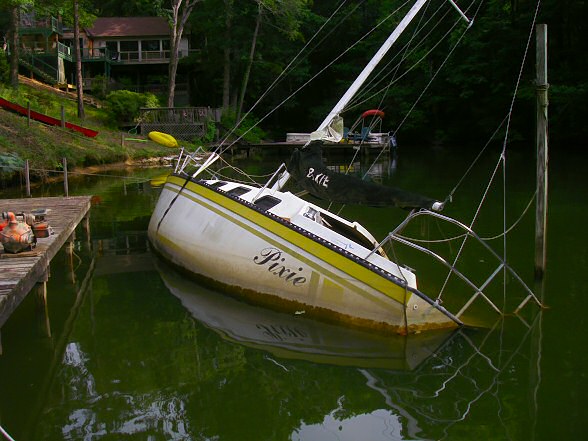
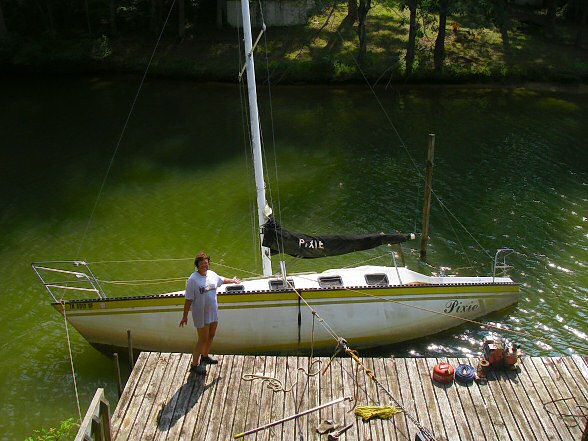
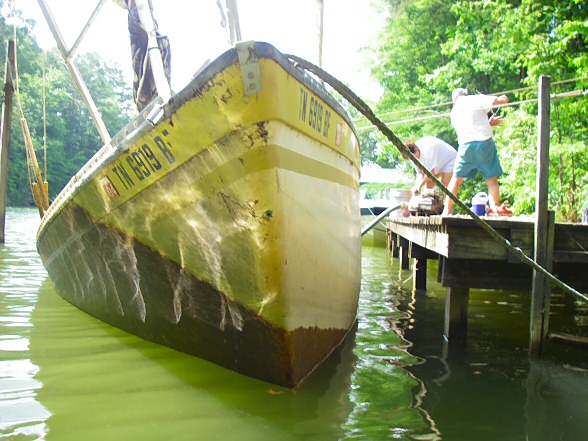
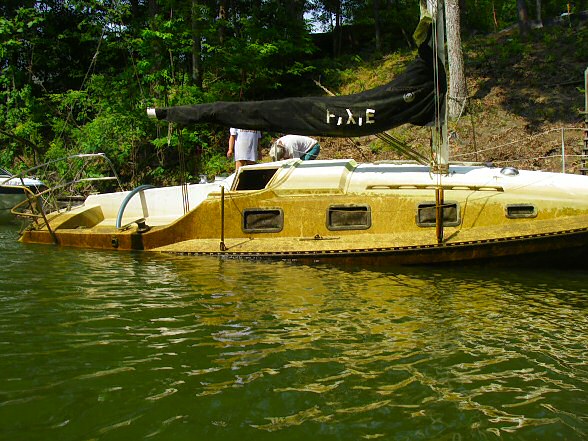
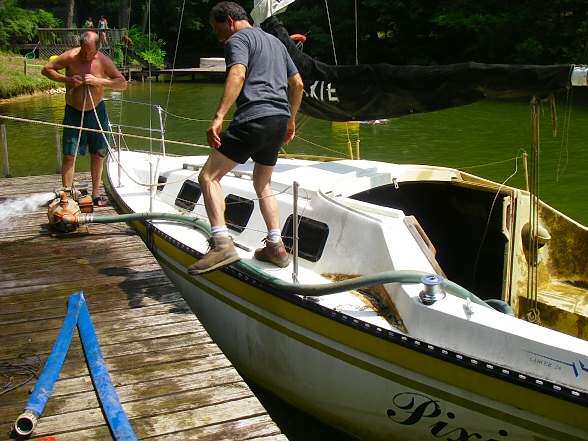
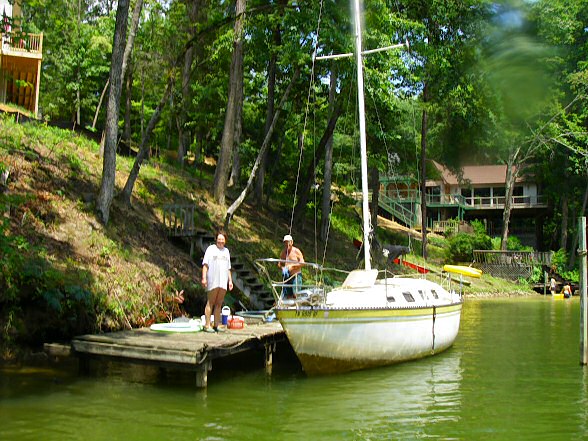
I think the plan now is to figure out how to get the thing completely out of the water and parked in Jay's yard, where he can work on it at his leisure over the next couple years. It's a Lancer 28, by the way, and should make a very nice boat. Of course, the inside is ruined, but there wasn't much in there, anyway. I figure, even the bulkheads will have to come out. The sinks might be salvageable, but not much else.
Anyway, after staring at that boat for more than two years, I was tickled to be part of finally getting it out of there.
June 9, 2011
Shake and Bake
Oy, it was hot yesterday two days ago, as it was hot the day before, as it is hot today, and so on. Spring mid-nineties, under the relentless sun.
But the wind was blowing, and I really hadn't made a day of it like I should, yet, so I untied, blew the departure horn, waved promises of return to Sweet Cheeks looking and acting demure on the dock, hoisted sail at the end of the slough, and was off.
Had I not been coated in the best in 60 SPF I'd have been toast in short order. And the big jug of ice water was almost not enough. There is more to sailing some days than just handling the boat. Some days out there, you have to contemplate eating your sled dogs.
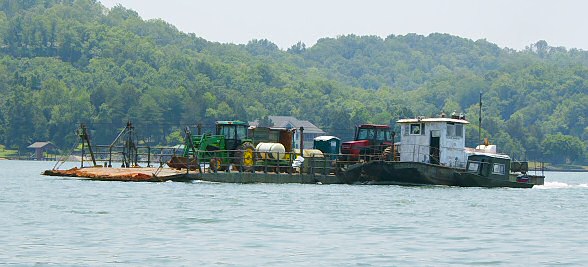
So, imagine my surprise, some five miles into my journey, ostensibly wide awake and attentive, I suddenly noticed a half mile off, what I should have seen at a mile and a half or more: a large tugboat pushing two enormous barges in my direction. While the ensemble was not dangerously close, I was exactly mid-channel of the Tennessee River, under sail, and the wind wasn't blowing with any particular steadyness. I was averaging a solid 2.1 mph at that point.
Here's the scene…
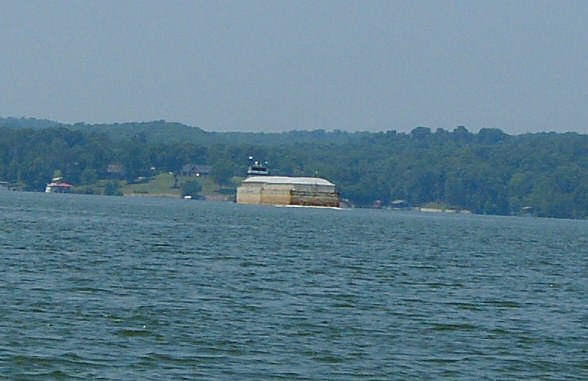
I recognized the tug almost instantly, even hidden behind the barges, because I'd blogged about the same boat at least twice before, once respecting the fact that Bearcat has been involved in three fatalities (two of her captains failed to see small boats in their path, running them over) in the area over the last three years, and because I photographed her working barges through Watts Bar Lock last year.
In the pic above, Bearcat is just coming out of the maintained channel East of Half Moon Island, and beginning to make a starboard turn to follow the river toward Knoxville. Just before the pic was taken I was heading across the bow (left to right) of the approaching tug.
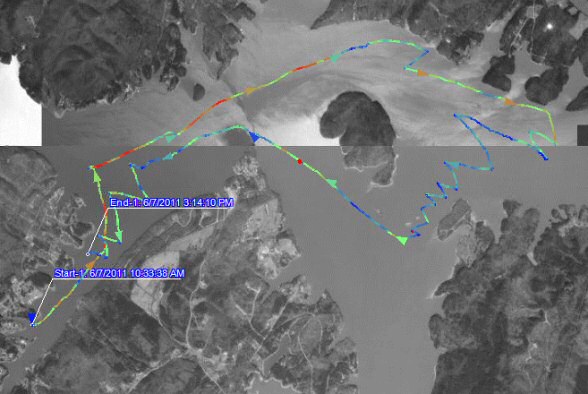
Distances are hard to gauge on the water. As it was, had I held course or even heaved to, the barge likely would have turned inside me and missed me by a wide margin, but I judged things otherwise at the time, and tacked back to port, which actually took me back to the middle of the river (as judged in retrospect with the aid of maps and my GPS log). It's possible that the tug was forced to go wider around than it might have otherwise. Exciting.
Got to be careful out there.
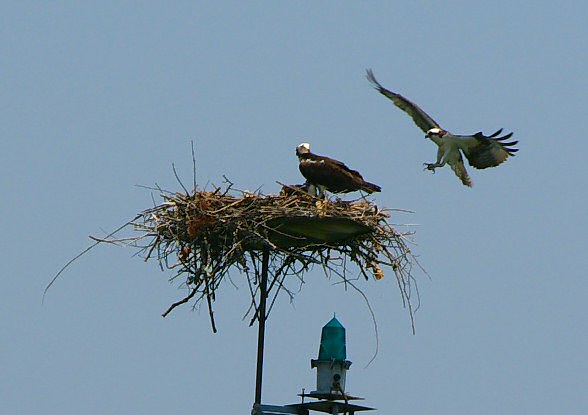
Later on…
March 28, 2011
Words for the wise
From The New York Times, November 29, 1885 (PDF):
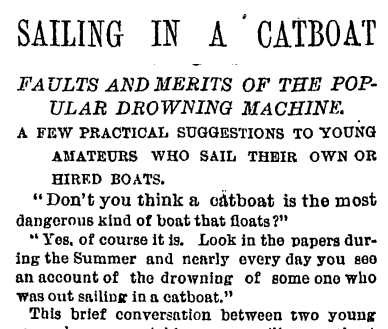
The story includes the following helpful advice…
Never jibe a catboat in a fresh breeze when you have ladies on board.
November 13, 2010
Catboat pile up
I've been saving open windows for about half a year. In no particular order…
The Catboat, from the Rudder, circa 1925:
Theoretically, the cat rig is the most efficient driving sail as well as the simplest to handle. Actually, the sail is of such size, and the mast and spars so heavy, that the handling by a novice is sometimes more difficult than would be the case if the sails were divided up as in a sloop or yawl. In light weather the catboat is a wonderful craft, for the big sail takes advantage of every breath of air and turns it into power. In beating to windward they will sail closer to the wind than any other type. With the wind astern the cat is at its worst. The boom, often longer than the hull, is entirely over on one side, and the rolling of the boat may cause it to dip deep into the sea, even with the topping-lift well set up. With a fluky breeze astern, the catboat man must watch the sail carefully. If, during a lull in the breeze the sail should trip in the water, the boom will come aft to a point where the next puff may get it on the wrong side and send it sweeping across the deck and over on the other hand. When the slack of the mainsheet is taken up, the boom will come to a sudden stop. If there is much weight in the wind, the strain may break the mainsheet, the boom or often the mast.
When caught out in a rising wind, the careful sailor will first drop the peak of the sail. This quickly reduces the sail area and slows the boat up so that one can reef her. If you wait until the wind has reached too great a velocity, you may find that reefing is too great a strain unless you have plenty of help. This is particularly true when the boom extends a great way over the stern. If reefed in time, a cat is as seaworthy as any boat of its size and shape.
Must have: The Gaff Rig Handbook: History, Design, Techniques, Developments, by John Leather.
Pictures of Silent Maid, from a 1928 issue of Sailing Craft.
There is no date in the history books stating the launching of the first catboat. However, 19th Century pictures abound and records show an increased number of flat-bottomed, single-sailed boats being put to work on the East Coast. In the 1800s, catboats were used for three purposes; carrying cargo, fishing and pleasure sailing.
Catboats were used in harbors to transport goods from large ships anchored at the mouth of a harbor into the docks at shore. With their sturdy, flat-bottom construction close to the waterline and wide, open cockpit, catboats could be loaded quickly, scoot to shore for off loading and return to the cargo ship for another load.
More catboat miscellany from ChesapeakeCatBoats.org.
Find the "center of area" of your four sided sail with Sail Area Math.
See how your boat stacks up in the larger pantheon with Carl's Sail Calculator.
Ezra Klein, the moron, didn't know the word "tiller", and from the depths of his ignorance, lashed out at John McCain for using "tiller" in a metaphor.
Jersey Cats (with many fine pictures to match the text):
A charter cat set out on a great variety of expeditions. Before dawn they would drift out with a flotilla of sneakboxes laden with decoys in tow. The guide would lead his sports to a favored sedge and moor the cat to it sending the sneak boxes out to hide in the reeds. When the hunt was over the cat would tow her charges home, possibly providing a warm beverage in the process. All manner of fishing expeditions were undertaken both for pleasure and profit and at all hours of the day. In the shell fish industry the cats provided a base of operations for a fleet of garveys and some were even built to operate as buy boats. Crabs, bluefish, flounder, shad, stripers, sea bass and numerous other species were to be readily caught along much of the coast. On the way to and fro to these fishing and hunting spots many an impromptu race was undertaken and it was inevitable that more formal contest should be arranged with cabins left behind and rigs tuned to perfection or at least with the sail stretched out as best it could be.
May 17, 1886 – New York Times (PDF): "Capt. Killmer, of the steam yacht Zephyr, last evening reported the capsizing of the catboat Ada and the drowning of all on board. How many persons were drowned he did not know, and the names of the parties on board could not be ascertained last evening."
Wish list: The Catboat Book, by John Leavens.
The Voyage of the Dronningen af Danmark to China in 1742. The Dronningen af Danmark was no catboat, but ship life in those days was arduous in a way that is difficult to comprehend in these.
In Defence of the Lugsail Yawl:
Over the centuries these rigs have evolved to be the best suited to a hard working life at sea in small boats. As our boats have a good deal of workboat DNA in them, why would I presume to know better? After hundreds of years and millions of sea miles I’d suggest they’ve been well and truly proven.
A few weeks back someone asked about putting a cat rig on a Stornaway. Here’s why I wouldn’t.
Catboat Mary (1893), with a fabulous picture (Be sure to appraise the hi-res version.) She ended up abandoned at sea, in a raging gale. Interestingly: "Two years ago she was built by Town of Staten Island […]". I wonder if contributions were voluntary.
October 23, 2010
Distance
So that's what I look like!
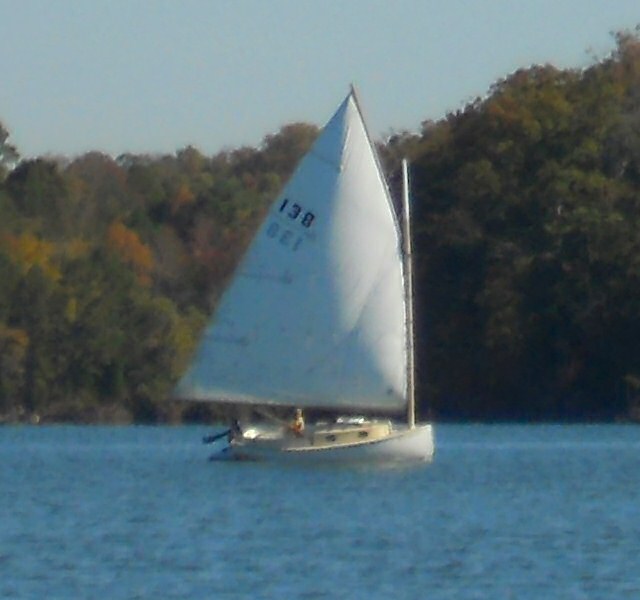
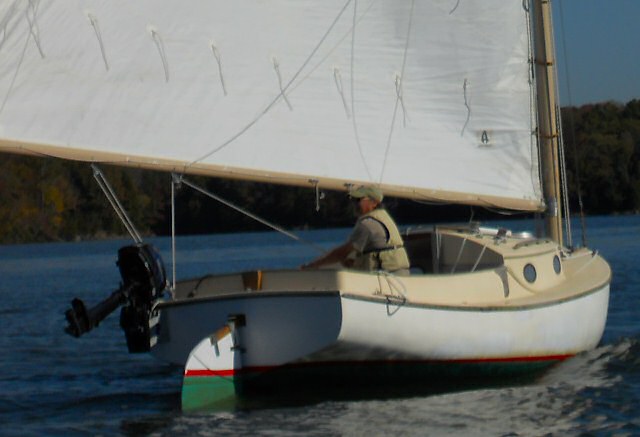
That's the first picture of Weave sailing ever taken from an external vantage point. Or at least the first I've been able to get my digital mitts on. I was just cruising gently along, there.
Photo courtesy of Sweet Cheeks, herself, who just happened to be motoring by.
Beautiful fall day. Had the sail up for over four hours. Forty minutes of that I spent basking in the autumn sun, flat out on a bench, with my head on a cushion, staring at the sky, making half a knot, semi-randomly. And then I spent a couple hours with my feet propped against the opposite bench, heeled over near twenty degrees, the sheet really testing the muscles of one arm and the tiller straining the other. I may have hit an adrenaline pumping five knots.
Saw a small flock of Coots, out there. American Coots, at that.
Bonus pic:
September 30, 2010
Catboat versus Trimaran
Almost thirty times out sailing (or attempting same) in the last three months, and only twice encountered another boat under sail.
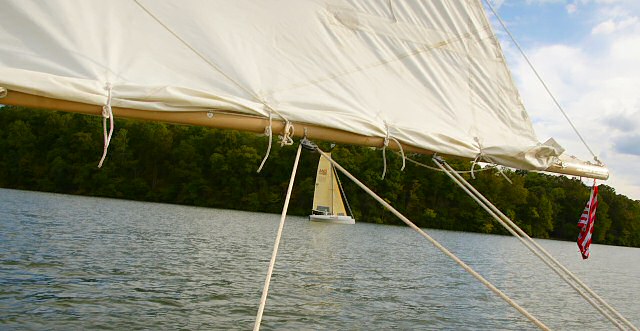
Two days ago, a fellow in that rig blew past me out by Half Moon Island, didn't appear to going too fast, so I turned and gave chase. Fortunately, winds were very light, or I wouldn't have had a chance, but I held my own, maybe even gained a forestay's thickness over half a mile. And that was with one reef in and the sail not hanging right all day. Just off Whites Creek, he pointed higher than I was able to, tacked around behind me, and sailed in close for mutual inspection.
Turns out, that's a fancy little French boat, a twenty three foot trimaran, called the Multi 23. The whole thing weighs between six and eight hundred pounds (variously reported), or a fifth to a quarter what Weave weighs. Had the wind been blowing more than just a jot, the trimaran would have blown my hatches off.
More better looks at it here.
Nice to see out there. Gotta be a fun way to go.
July 14, 2010
Still rockin’ and rollin’
What a great day, bouncing along in the wind driven convection oven. Almost four hours of it, with the constant tug of the main sheet on one arm or the other, keeping the tiller pointed with the opposite, cooking in the white cockpit at something over ninety degrees Frankenheit. There's nothing like it. When the wind fills that sail, every part of the boat knows it, and then it's just a matter of trying to take advantage of it and keep it under control. Had a blast. And I'm still feeling the waves.
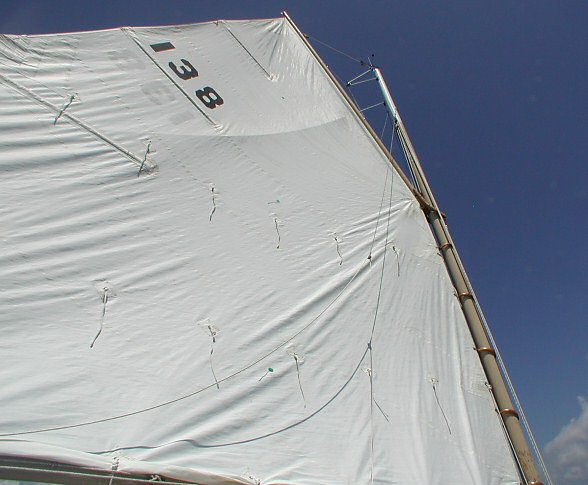
The sail looks more wrinkly (that's sailor technical talk) in the picture than it did in action. I think the camera accents every little defect, especially across broad swaths of white. The line the topping lift cuts as it sags across the other side of the top of the sail looks more pronounced than it was, too. The line was slack, with only the weight of the blocks at the foot of the mast applying any tension.
Still, the sail in the picture isn't demonstrating the classic, powerful, efficient shape that one wants. Of course, every moment is different out there. The boat is constantly changing pitch with every wave it encounters, whether such waves are wind driven or arriving randomly off the wakes of the multitudes of power boats. The wind, too, is usually highly variable, changing direction on a whim, and every puff also changing the attitude of the boat. And the pilot has his druthers about where he wants to go, how he thinks he's going to get there, etc., and can throw his own weight around to affect things. Take the hand off the tiller for a minute and everything can go to hell. There are a whole lot of variables in play. Going downwind, even the weight of the boom sticking out over the side leans the boat over, calling for a correction with compensating weight, and/or a tiller adjustment.
There are ways of adjusting that sail that I don't bother with. There are probably aspects I don't even know about.
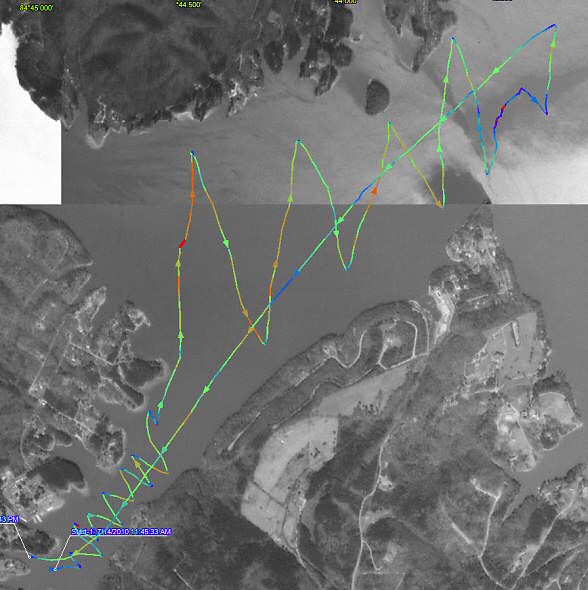
There's the mad weaving against the wind, all the way out. I could motor that first distance in nothing flat, but it's fun to bounce off one side of the branch and then the other.
The GPS track is color coded according to the speed of the boat. The blue tips of every tack show the slowness in turning. Red is the fastest, with brown next. Top speed today was 5.5 mph. You can see where the wind almost died out in the upper right corner, and then gave me a little more, while I decided to head for home. Fortunately, it slowly picked back up, and I had a nice straight shot, probably three miles, all the way home. The heat was something else, though, with no apparent wind in the cockpit.
Tomorrow looks like a duplicate of today, only warmer.
June 30, 2010
Sailing, sailing…
Sailed twice today, maybe racking up a mile and a half, total. I was working the sail/reefing setups and not intent on making tracks, but the winds in the branches and sloughs are interesting. On certain days, it is almost impossible to sail out of certain narrow channels. The wind blows off associated peninsulas at different angles than it blows between peninsulas, meaning that one can be trying to sail upwind against two different winds, trying to split them. Today, I also had the pleasure of no wind, and eventually called it quits to get myself out of the relentless sun rays.
The boat is all set up, now. Only a couple months behind schedule.
June 28, 2010
Ship shape
Operations were delayed on account of some sort of malady that encouraged me out of the heat and into fitful slumbers. And then company arrived and endeavors had to be woven around and through. But don't doubt, endeavors were strenuous and extended.
But I had a small sail noonish today, even before some of the ordinarily necessary adjustments were incorporated, even in the stormyish atmosphere. All went better than swell.
I moved some of the lead ballast around in Weave's navel for a beneficial attack profile, but can't comment yet on the effect on handling. I think I need more lead. Lead is good. Lead is heavier than most other stuff. I want more of it. I don't want to pay shipping!
And then I spent actual hours looking around all my various repositories for the little plastic envelopes with the electrical butt joint splicer things so I could finish wiring the mast light to the main boat grid, but never found them, so I wired it up temp like, just to give it a test.
The picture was taken near dark, with the shutter staying open for (seemingly) two seconds, but it's not too bad. (It occurred to me that digital pix tell all. It was a two second exposure.)
The new LED is all it should be. The previous incandescent version was a joke, but the new light errs toward the other end, if it errs at all. It lights up the wind indicator with panache.
June 21, 2010
The cat’s pajamas
In the morning light…
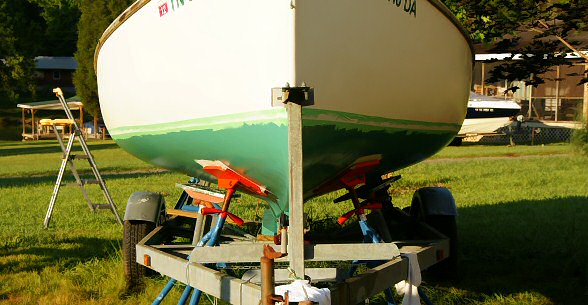
The Interlux BottomKote went on smooth as silk, and didn't fall in big sheets onto the grass overnight.
Success!
The stuff really glistens with the morning dew. Cool as hell, if I do say so myself.
Second coat goes on soon!
June 20, 2010
Slow boat
Sailing, sailing, over the bounding lawn…
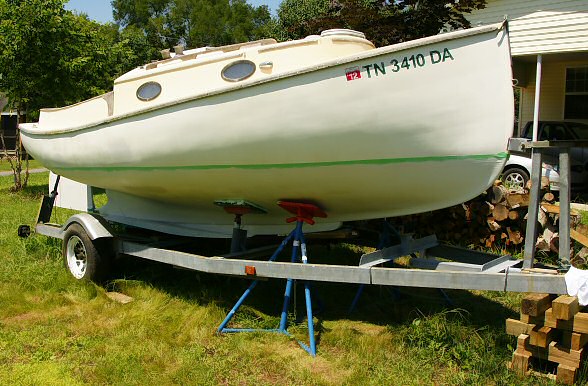
Wot a project. And I've hated it every bit of the way. But it's almost done.
That's Weave, the Cape Cod Catboat, sitting in her partially dried second coat of bottom primer. In a few hours, we'll attack with the ablative anti-fouling paint.
It seems like months ago I started sanding that bottom, which was a nightmare in itself. Just crawling around under that boat gives me the heebie jeebies, especially after I witnessed the unloaded trailer crash to the ground once, when the rusty pin locking the front wheel in place snapped. What's to say some other part won't snap or sag while I'm under there?
The auxiliary crank stand I ordered didn't add anything to the safety side of the equation, and wasn't enough to hike the boat the way I needed, so I ended up ordering a pair of real sailboat stands, but it was veritable heck getting them in place. I ended up tilting the boat and trailer back to make it so. The blue stand there is half the pair, shoved to one side a little, so we could paint. In a little while, I'll reposition it, crank it up, and lower the other pad to paint that area.
Blisters, holes, and gouges were filled with a couple different 3M marine filler products, tres expensive, but excellent stuffs. Primer prep involved cleaning the whole bottom with a noxious solvent wash (I acquired brand new respirators for both Sweet Cheeks and myself, which were used throughout.) And then the epoxy primer, the Interlux Interprotect 2000E, even more noxious than the 202 solvent, should seal the bottom of the boat nicely. It has micro-plates!
Next up is the Interlux BottomKote, which will keep the algal blooms at bay, theoretically. That stuff is pure poison, apparently, until it dries, and then only poisons marine creatures who land on it. You bet.
So, the boat may end up in the water around about Wednesday, completely missing our lovely Spring. We have to touch up some of the top side paint, too (we'll leave the major portion of that for another year), and put the red stripe back around at the water line (it's hung up to dry in the laundry room), but those are things we can do standing up, and we like that.
June 10, 2010
The worst
Abby Sunderland, sixteen years old, attempting to sail solo around the world (from San Francisco, I believe*), and just having passed the half way mark, may have capsized in heavy seas in the middle of the Indian Ocean. The nearest ship is now less than 40 hours from her position (which is probably known), and a plane is on its way but will only be able to make a visual assessment, with a short try at VHF communication, if the pilots can spot her at all.
Her blog is here.
Her boat is equipped with everything in the way of safety equipment, and Sunderland seems fairly prudent, so she is very likely okay. I suspect she took on a little too much water, and is not having a very good time of it, but will hang in there. I can't imagine making it as far as she already has without the fortitude to wait it out a little longer.
Keep your fingers crossed.
* Make that Marina del Rey
UPDATE: Sunderland was spotted from the search plane, the pilots spoke to her, and she's fine. Mast down, etc., but boat otherwise intact and upright.
February 14, 2010
The America’s Cup is America’s again
Two fabulous races, and the BMW Oracle team pulled them off in style.
That's just an incredible boat.
I wonder how many she sleeps.
October 5, 2009
“The sea howl, And the sea yelp”
Another kid wants to attempt a solo sail around the world, but the busybodies are accumulating:
The Premier of Queensland Anna Bligh, who’d been a supporter of the teenager’s voyage, joined those who were now questioning the wisdom of her adventure.
It turns out that PofQ Bligh can claim family connections to our long gone friend, William Bligh, who rose to the rank of Vice-Admiral in Her Majesties Navy, but as a Lieutenant had the unfortunate experience of captaining the HMS Bounty when her crew mutinied. He was set adrift with eighteen of the non-mutineers and few provisions. What then transpired has gone down in the history books as one of the most remarkable feats of seamanship ever recorded, as Bligh took his men, on something less than starvation rations for the most part, more than 3600 nautical miles in forty seven days in a boat almost continuously in danger of capsizing, and lost only one man, and that because of hostile action from some island dwellers.
Fortunately, PofQ Bligh has neither to find the wee dram of sea salt still in her blood, nor to trouble herself in any other respect over the matter. The kid is old enough to do what she wants, and PofQ Bligh’s wavering instincts are constrained, at least at present, by the vagaries of the law she serves.
Good luck to the kid. Nice boat.
September 27, 2009
Einstein, the sailor man
A person in a forum stumbled across a picture of Albert Einstein (with a woman who isn’t Olive Oil!) in a sailboat, and wondered what type of boat it might have been. Someone guessed a catboat, but I don’t think so. Not with those side stays, and the mast is too far back.
I took a luke around and was intrigued to find that Einstein did enjoy the "sport", reportedly because it required so little effort. He sailed from at least the age of eighteen onward, until ill health forced him to stop. He didn’t particularly care about going fast, or going anywhere at all. He liked the play of wind and water, and the quiet, and out there by himself, he could think.
For his fiftieth birthday, which was in 1929, well after he became famous, some "very rich friends" gave him an expensive, specially constructed boat of about seven meters length. Though the boat was named Tümmler (porpoise), Einstein called it his "thick sailing ship", possibly because the designers made it "thick" to conceal the motor that Einstein didn’t want to show in any way.
That last link (which has a few pictures) tells how not long after Einstein fled Germany the boat was confiscated by the Third Reich. A news item carried the tale:
"Einstein’s speed motor boat confiscated. The speed motor boat of professor Einstein which was moored at a shipyard in Caputh near Potsdam was confiscated and seized for the Reich. Einstein is said to have planned to smuggle the sailing boat into a foreign country. The sailing boat is worth RM (Reichsmark) 25,000."
He never got it back.
In the U.S., Einstein seems to have enjoyed handling smaller boats, in which he showed his carefree spirit, eschewing motors and life jackets, braving rocks and shoals and the weather, even though he never learned to swim, apparently. He had to be towed home more than once, and at least one time was pulled from the treacherous deep by a lad in a passing craft. The little boat he owned, possibly the one in the second link from the top, he named Tinef, which is Yiddish for "junk", or maybe "worthless".
Another blogger assigns a picture of Einstein and a sailboat to "Saranac Lake in upstate New York", but the picture is of the sailboat that the Germans seized. I tried to comment, but it didn’t show. Oops. It’s there now, thanks to the miracle of the moderation queue, I deem.
Also, later: A photo here and one here (two different web sites, but the photos apparently taken only moments apart, seventy two years ago) may show the same boat in the picture that spurred this post.