
August 22, 2023
InBev: A Funny Thing Happened on the Way to the Forum…
I guess the Bud Light conglomerate continues to suffer. Skeptical of all, I have to say that absent news that sales are good, it looks like doom and gloom is the new modus.
Though it really is a scenario that’s new and improved, as the old advertising saw used to go, though it’s not being promoted as such, in any sense, in this case. The main stream media doesn’t exactly know how to report negatively on the people they’re striving to use to move their agendas.
It occurred as it does the other day that a 25% decline still meant a solid 75% base sales customer, and surely that’s not bad.
Of course, modern businesses run in the very small percents, especially with half of humanity’s expectations that they deserve some of it…
But it’s all a little bit outside the box of what’s usual, innit?
Another story tells of the reimposition of masks and distancing in certain locales, and one wonders when something more substantive than a beer drinker revolt is likely to make the news.
August 5, 2023
If We Weren’t Crying All The Time, We’d Have to Laugh…
Lizzo is down! Lizzo is going down!
Still, there be nuggets of joy in these times. If not humor…
“Lizzo’s only recourse, I guess, would be a People magazine cover story. But even that is dicey at this point.”
Dicey times, indeed.
October 11, 2022
Yep
So sorry for the interminably maudlin junk of this digital journal. I’ll leave it here, just as a lesson to myself, for the time being. I shoulda known better, and probably still won’t, soon.
February 16, 2021
Sturgeon
While the Subway tuna sandwich contretemps slowly steams like a young man’s dreams to the requisite chiaroscuro of inconsequential-ism, a recent plethora of unbidden TeeVee commercials has me wondering about the new Popeyes fried flounder sammiches. Oh, yeah.
Breaded and flied flounder? Who would do that to those poor, delicate darlings? I mean I know people will fry anything… but flounder? The fish is so skinny that even God couldn’t fits its eyes on opposite sides of its head. Any kind of breading is going to be thicker than the meat. If it’s flounder, it’s going to be fish-flavored breading, like Veal Schnitzel with heavy on the Schnitzel.
Or maybe not. I’ve never been anywhere near a Popeyes, that I know of, and have not sampled any of the conglomerate’s wares. Not that I wouldn’t buy any one of its offerings if circumstances so led, just that the occasion has never had the occasion.
So where are they getting all those skinny filets? The Pacific North West? For cheap? How many people with poles reeling them off the bottom are employed in the endeavor? Are there farms or proto farms?
Great Fabulous Great no matter what the answers are!
I LOVE flounder. If I could get flounder like I can get catfish or tilapia, I’d cut way back on catfish and tilapia. And I wouldn’t bread it up like I do catfish and tilapia. (Which I haven’t done for a while.)
I just have a vaguely formed opinion that flounder is less easily obtained in quantity than tuna, but maybe my ideas of quantity are out of date. There are oceans out there of which I know almost nothing.
I am the whale. I am Ahab. Call me Ishmael.
Fishy.
April 3, 2016
I smell roast chicken
Found a piece of paper sticking out of one of my grandmother’s books today…
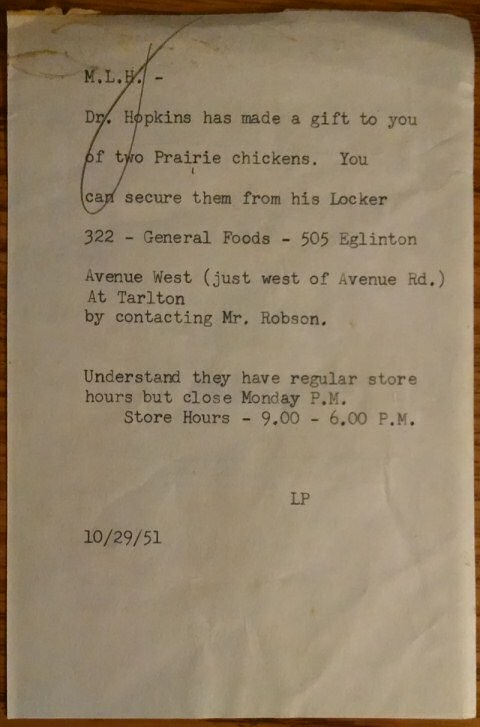
The address goes to Toronto, Canada, where I do believe my grandfather worked for a year or two.
I can picture my grandmother throwing those birds into the oven roasting pan (probably the same pan sitting on a shelf in the next room) with great gusto. And probably some potatoes and carrots. I think she cooked everything the same way.
It was the fifties.
July 31, 2013
Double the salaries, double the unintended consequences
Maquire has a post up making mock of the math in a HuffPo piece proposing McDonalds could double the wages and salaries of every employee in their biz, and need to raise menu prices by only a small, insignificant 17 percent to keep their bottom line stable.
Maquire sez the undergrad student "researcher" is off about 50%, suggesting a raise in prices of 26 percent, and while I suspect the detailed particulars of taxes, say, would make it more than that, I'm not going to split the hairs of McDonald's annual report at this hour (or ever.)
Much fun is made in the comments respecting the idea that raising prices 17 percent results in a 17 percent increase in revenue.
But here is another aspect I don't see mentioned…
Raise the base worker wage from $7.25 an hour to $14.50, and what do you have? You have a job that I might apply for, because I can do those jobs with my eyes closed. It's a clean, professional, if cacaphonous, environment, with delineated duties and straight lines of authority. Yadda yadda.
How well does that bode for the schmoe looking for his first job out of high school? Not swell.
So, the guy the $14.50 was supposed to benefit ends up with no job at all.
Way to go, undergrad student "researcher".
ps. The same goes for doubling the salaries on the corporate side, which the HuffPo theory included. Honest secretaries at the home office might find themselves slowly replaced by guys with MBAs from Harvard. Etc. Etc.
January 31, 2013
Gun market
Sweet Cheeks and I stopped in at a local sporting goods emporium today to have a look at weapons commerce. Practically the first thing out of the front desk guy's mouth was, "We're out of .22 ammunition". That's what half the people through the door recently are looking for, allegedly. Sorry.
At the back of the place, they had about a dozen ordinary shotguns for sale, and exactly one .22 revolver and one Glock. Plenty of display cases, but they were all empty.
A pistol I asked about might take a month. AR anything is out of the question for the foreseeable future unless the (rightful) paranoia settles out.
Referencing the likely pending Gestapo friendly government helpfulnesses, the nice employee opined that large magazines would likely be taken off the market for average joes like me and Sweet Cheeks, but that the two "characters" lounging off to the side would still be able to acquire same, whereupon one of said characters said matteroffactly, "We already have 'em."
That's when you like people.
ps. I probably should have bought the .22. Even without any ammo.
November 17, 2012
A question
How can Spring City Cable, in business for over twenty years in Spring City, Tennessee, not have its own web site? They’re trying to sell high speed Internet access, for crying out loud, and they can’t so much as muster their own [digital] advertisement of themselves? Welcome to the boondocks.
February 9, 2011
Priceless
The whole is not greater than the sum of the parts, apparently:
With 106.7 million shares outstanding, that means AOL has shed $315 million in value over the last five trading days — which happens to be exactly the same price AOL agreed to pay to acquire HuffPo.
But not to worry. As the President says, at a certain point, they've made enough money.
February 8, 2011
Full speed ahead
There never was a problem with the electronic components of Toyota accelerators.
It took the government about twice as long as everyone else to figure it out.
Corporate blogging
HuffPo pulled itself up with some hefty bootstraps, much of its alleged success owing to a stable of celebrity and unpaid bloggers. Arianna lent the enterprise a certain cachet, but I wonder how all those folks are now going to feel about contributing their work gratis, to AOL's bottom line (and shareholders.)
February 7, 2011
Sickly
The zeitgeist for medical manufacturers is not good.
Device-makers are having a terrible time getting new products that might give them pricing power approved by the FDA. Health reform adds a new 2.3% excise tax on many of the companies (though not lab equipment). And there’s demographic evidence that the number of baby boomers whose creaky knees and bad hearts fueled a decade of explosive growth for many medical manufacturers has peaked. Many of those patients are close to or already becoming cost-controlled Medicare patients.
Health reform points to a world of centralized rationing through Medicare and a return to capitated payments by private payers. This is not the time to be selling fancy new hospital equipment. From a societal standpoint, a slowdown in spending may not be a bad thing.
I don't quite understand that last sentence. It appears to be some misplaced editorializing.
But about those baby boomers, eh? What's the likelihood that the most self-indulgent generation the planet has ever known (until the next generation assumes its place, if it survives) is going to go quietly into "cost-controlled Medicare" patient-dom? With any luck, the geezers will burn the place down.
January 26, 2011
Squeezing the turnips
I'm not a Facebooker (though Sweet Cheeks is up to her carpal tunnels in it) so I might qualify as an uninterested and detached observer. I'm also pretty uninformed as to FB's underlying financials, so take the following with a lot of salt.
When I see stories like, Facebook to let advertisers re-publish user posts, all I can think is that despite all the rosy valuations, Facebook must not be doing all that well financially. Why rock the boat, if there isn't a dire reason to do so?
Seems funny, that's all.
March 21, 2010
Concretes
It's time for the big push, but it's raining, so what the hell.
I'm talking about another 2400 to 3000 pounds of concrete that needs to be dumped in the lake. Or between the lake and the homestead, in carefully defined piles, before the Spring waters rise and make work impossible. And that's on top of the 3460 pounds already mixed and installed this year. If I kept track of things last year, I've misplaced the stats, but we've already surpassed those previous efforts.
The thing is, the economics of concrete, at least as it pertains to concrete in the form of Quikrete, or the premixed stuff that only needs a little water to set it free, is somewhat puzzling.
Last year, being new to the concrete game, and new to the heave ho of heavy bags of rocks, I bought a seemingly endless stream of 40 lb. bags, and was able to slash and dump them straight into the mixer. But a 40 lb. bag at Lowe's costs $2.84, while 80 lb bags go for $3.85, at least at one store. Over the course of scores of bags, that difference adds up, as the kids would say if they could get interested in math.
This year, being the newly cost conscious earnest fellow that I am, and also being cognizant of the fact that all the big boys buy 80 lb. bags, and that the extra exercise would be good for me, I started buying 'em big.

Well, Lowe's is twenty three miles away, with a town or two in between, and it's a drag to have to go that far just for ten bags of 'crete. Galloway's Ace Hardware, on the other hand, is only eight miles away. The trouble is, Ace Hardware in Spring City wants $5.19 per 80 lb. bag. It's ridiculous. I bought a couple loads there, but no more.
Then, this weekend, I chauffeured Sweet Cheeks to a Chattanooga do where she spent the weekend, and on trips back up the pike, stopped at the Lowe's in Dayton, and they were letting bags of Quikrete go for $3.46 each. That's a twenty six mile trip, one way from here, but it's the way to go, man. I'll drive past Galloway's every time, and it's their loss. That's $1.73 per bag, or $17.30 per trip, plus the state's share of the thievery. I can do the math.
March 1, 2010
Lessons
Now, finally, here is a cheerful sort of story. It's not OUR story, of course, but still it warms the heart to know that there is competence and responsibility hiding in the unlikeliest corners somewhere. It's the story of the amazingly untroubled mortgage and banking system in dear old Canada. Yep, those crazy Canucks have so far weathered the worldwide economic buffetations without a single bank closure. It's a nice story, so read it, won't you, along with the necessary importances:
1. Full Recourse Mortgages in Canada. Almost all Canadian mortgages are “full recourse” loans, meaning that the borrower remains fully responsible for the mortgage even in the case of foreclosure. If a bank in Canada forecloses on a home with negative equity, it can file a deficiency judgment against the borrower, which allows it to attach the borrower’s other assets and even take legal action to garnish the borrower’s future wages. In the United States, we have a mix of recourse and non-recourse laws that vary by state, but even in recourse states, the use of deficiency judgments to attach assets and garnish wages is infrequent. The full recourse feature of Canadian mortgages results in more responsible borrowing, fewer delinquencies, and significantly fewer foreclosures than in the United States.
2. Shorter-Term Fixed Rates in Canada. Canadian mortgages carry a fixed interest rate for a maximum of five years, and rates are then re-negotiated for the next five years, similar to a five-year adjustable rate. This practice allows banks to achieve a better maturity match between their assets (mortgages and loans) and interest income, and their liabilities (deposits) and interest expense, which protects them from the kind of maturity mismatch and interest rate risk that resulted in our S&L crisis and almost 3,000 bank failures in the 1980s and 1990s.
3. Mortgage Insurance Is More Common in Canada than in the United States. About half of Canadian mortgages carry mortgage insurance (compared to 30 percent in the U.S. currently and only 15 percent before the crisis), primarily for those mortgages financing the purchase of a home with less than a 20 percent down payment, and the borrower is required to pay the full mortgage insurance premium upfront. Another difference from the U.S. is that when private insurance companies in Canada insure mortgages, they have the authority to approve or reject the property appraisal, and they have strong financial incentives to only approve realistic property appraisals. Mortgage insurance in Canada covers the full loan amount for the full life of the mortgage, and cannot be eliminated like in the United States when the property value exceeds the mortgage balance. The traditionally much higher frequency of mortgage insurance in Canada compared to the United States helps to stabilize Canada’s mortgage and housing markets, and is one of the many features that contribute to its ranking as the safest banking system in the world.
4. No Tax Deductibility of Mortgage Interest in Canada. Home mortgage interest has never been tax-deductible in Canada, so there is no tax advantage to home ownership in Canada over renting. There is also no tax benefit to converting home equity into household debt in Canada, which has resulted in a much greater equity accumulation in Canada (70 percent of total real estate value) than in the United States (currently only about 45 percent). Also, paying down your mortgage in Canada is a tax-free investment and further encourages greater equity accumulation than in the United States. Interestingly, even without any tax advantage for home ownership, the Canadian homeownership rate (69 percent) is actually higher than in the United States (67.2 percent).
5. Higher Prepayment Penalties in Canada. Prepaying mortgages in Canada is allowed, but there are much stiffer prepayment penalties (three months of mortgage interest) than in the United States, which discourages the kind of refinancing that frequently took place in the United States leading up to the housing meltdown, and often involved pulling home equity out in the refinancing process (encouraged by the tax deductibility of mortgage interest).
6. Public Policy Differences for Low-Income Housing. To promote affordable housing for low-income households, the Canadian government has not used public policies like the Community Reinvestment Act in the United States, which encouraged homeownership for lower-income and less creditworthy borrowers, financed frequently with subprime mortgages. Instead, the Canadian government provides public funding for low-income rental housing, rather than encouraging homeownership for low-income households, and Canada has thus avoided the American mistake of using misguided policies to turn good, low-income renters into bad homeowners.
7. Differences in Canada’s Bank Concentration and Greater Diversification. Compared to the United States, the Canadian banking system is much more concentrated, with the five largest Canadian banks (out of only 82 in the entire country, compared to more than 8,000 banks in the United States) holding more than 80 percent of total bank assets. This concentration became an advantage during the recent financial crisis because it facilitated critical discussions among the five large banks and the single federal regulator (the Office of the Superintendent of Financial Institutions). Also, Canada has never had branching restrictions like the U.S. laws that prevented interstate banking up until 1994, and this has historically allowed Canadian banks to achieve geographical diversification for their deposits and loans portfolios. It was largely this difference in geographical diversification that help explains why the United States had 9,000 bank failures during the Great Depression (each operating within only one of the 48 states, due to the prohibition on interstate branching) and not a single Canadian bank (all with branches nationwide) failed in the 1930s.
8. A Few Other Differences that Contribute to Bank Safety in Canada. There is a much lower rate of loan originations by mortgage brokers in Canada (only 35 percent) than in the U.S. (70 percent), far less mortgage securitization in Canada than here, and a much smaller subprime mortgage market. Banks in Canada keep and service 68 percent of the mortgages on their own balance sheets that they originate and underwrite, which encourages prudent lending since banks are putting much of their own capital at risk. Finally, almost all mortgage payments in Canada are made electronically by an automatic payment arrangement, which minimizes late payments.
Bottom Line: Taken together, the features and regulations of banks in Canada outlined above create a healthy and sound “pro-lender” environment absent of political motivations for outcomes like greater homeownership, compared to the often politically motivated “pro-borrower” and “pro-homeowner” policies of the United States. While Canada’s banking system has promoted responsible borrowing and prudent lending and underwriting practices with little politically motivated interference, the U.S. banking system seems to have encouraged excessive lending to risky borrowers because of the political obsession with homeownership.
Amazing how unencumbered the Canadian market is with federal regulations. Marvelous indeed.
December 17, 2009
The price of computers just went through the roof
It's a good thing I bought the new machine when I did. The FTC is on another rampage. They're going after Intel, now, for being too successful. Unbelievable.

And who knew? I didn't need to buy a monitor, having extras on hand, but the new video card has two sockets, so I gave 'em a shot, and Windows pretty much knew what to do. You wouldn't believe how helpful it is like that. The cursor flies from screen to screen like nothing. Highly recommended.
November 11, 2009
“Seattle: We wanna be like Detroit!”
That’s a rueful laugh from the comments at Warren Meyer’s, under a post remarking on the reasons why at least two businesses have fled Washington State.
November 3, 2009
A duopoly falls
Interesting article on Google’s moves in the digital mapping world. Once again, they’ve turned the orb topsy, going one better than offering for free that for which others charge an arm and leg, and sorta like actually paying people to use their product. There will be some fall out.
I hadn’t even noticed that Google dropped NavTeq more than a year ago. Now they’ve dropped Tele Atlas, too. Garmin must be crappin’ in its pants (and I say, "It’s about time.")
Hmm. I wonder if static screen grabs of Google Maps are now legal…
March 29, 2009
Fascist Motors
The Obama administration asked Rick Wagoner, the chairman and CEO of General Motors, to step down and he agreed, a White House official said.
Wagoner’s resignation was one of the remarkable strings attached to the new aid package the administration is offering GM, based on recommendations from the Presidential Task Force on the Auto Industry, headed by the Treasury Department.
The White House confirmed Wagoner was leaving at the government’s behest after The Associated Press reported his immediate departure, without giving a reason.
Hmm. I wonder which model all the favored party leaders will be driving next year.
And I guess that old quote is truer now than ever: "[W]hat was good for our country was good for General Motors". Yes, we’re all getting it good now.
Bye bye, Miss American Pie.
Addendum, at Mises:
So too the Soviet system existed for 70 years with a general pattern that the head of state would blame all problems on the existing management of state-owned companies, that they were thieves, incompetent, disobedient, insufficiently loyal to socialism or whatever. It wasn’t the state, the intervention, the system, but always and everywhere the personnel–they had to be shot or imprisoned as a matter of justice–and if we could just get the right people in charge of the factories, it would be onward and upward to socialist utopia. The management served as the scapegoats, people for the public to blame all problems on as a way of distracting from the real problem. Something about this news suggests something along the same lines.
How soon before GM execs have the raving mobs screaming outside their homes?
March 10, 2009
Curse the freedom
In the U.S., there are BMI and ASCAP, whilst in jolly ol’ England there are the PRS (Performing Rights Society) and the MPA (Music Publishers Association). Today, both of them are "outraged… shocked and disappointed" that Youtube (owned by Google) has begun blocking music videos to the UK rather than pay the PRS rates and "lose significant amounts of money on every stream of a music video." The folks at PRS are suddenly apoplectic, of course, and seem to be a little confused about just whose interests it is that Youtube serves:
In a statement, Mr Porter said the move "punishes British consumers and the songwriters whose interests we protect and represent".
The PRS has asked YouTube to reconsider its decision as a "matter of urgency".
The body, which represents music publishers, added: "Google has told us they are taking this step because they wish to pay significantly less than at present to the writers of the music on which their service relies, despite the massive increase in YouTube viewing.
"This action has been taken without any consultation with PRS for Music and in the middle of negotiations between the two parties."
The nerve of those Youtube people for trying to hold onto their own money when the consumers and songwriters are so reliant on the service.
Hmm. Maybe the PRS should quantify that reliance before they proceed to price themselves out of the market.
Relatedly, it’s good to see that Google can stand up in its own self interest. But it’s a shame that that self interest seems to value only money.
Via: TechDirt