
April 15, 2017
Putt Putt
I took a picture of golf balls, then got all wrapped up admiring the crap piled on my desk. That’s Stonewall J. looking on. A “Make Happiness Your Aim” pencil/junk caddy. J. Fritz medal. Ancient automobile toy. Gun tools. Knives. Prednisone for a cat. Sweet Cheeks’s legs hiding behind the last post I made. A shirt button. Blue tooth headphones plugged into Asus monitor. Mechanical keyboard.
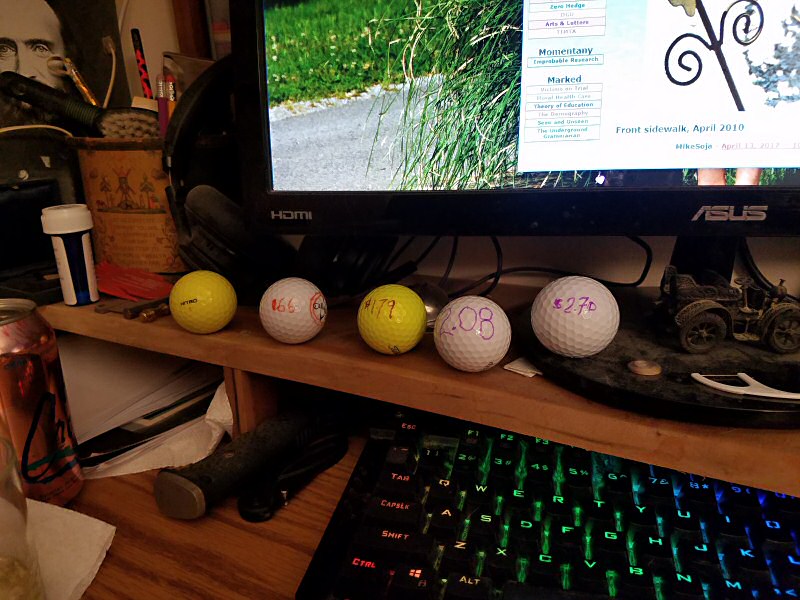
Anyway. When I re-took up golf late last year, every outing had me coming home minus anywhere from 18 to 24 balls. Gone. Lost in the woods. Sunk in creeks and ponds. Bouncing down country roads. Or just plain hiding in plain sight. It was a golf ball massacre. A bloodbath. To minimize the economic hit, I bought dozens of the ball on the left, the Nitro Ultimate Distance, for $4.98 a doz. at Walmart. That’s 42 and some odd cents per. Cheap. The cheapest. Not much more expensive than used balls, with the added benefit of being of a uniform nature and provenance.
They hit like little rocks. According to my research, they have an overall compression ratio of about 90, which means they hit like little rocks. Some of the balls the big Pros play have higher compression numbers (to better react to those higher swing speeds), but the most popular balls on tour are between 90 and 100. The balls the Pros use differ from the Nitro rocks in that they are ten times more expensive, and are constructed of several layers, each with its own properties, and their covers are “soft” yet durable (Urethane is the technological miracle, apparently). The Nitros have a core and a cover and the core is like a rock and the cover is soft but not durable (a form of Surlyn, aka trionomer aka tri-ionomer aka ionomer). Now that I’m not losing many balls, I find that the cover of a Nitro ball lasts me about nine holes, before it is scuffed and scratched all over.
The other day I lost just one ball, somewhat owing to unfamiliarity with the course I was playing, though the ball did not go in the direction that I had intended. The time before that, I lost four balls all day, three of them on a single hole. Sometimes it goes like that. Part of the reduction in losses is that I’ve largely corrected a horrendous slice offa da tee. And then it just comes down to playing smarter, not trying to carry the water that’s 160 yards off, etc., or, you know, not pretending that the ball can make it through those tree branches, there, this time for sure.
So, I started buying other balls, and teed them up whenever I felt the odds were low of losing them. But that was useless because it gave me no consistent overall feedback, as a game can vary widely over the course of a few hours, and who could remember which hole experience went with which ball. So, now I’m working my way through four different balls, picking one to play per outing, more or less, to see how they go.
The second ball from the left is a Callaway Supersoft, and cost $1.66. It’s a 2-piece ball like the Nitro, but has an overall compression number of 38 or 39. The cover does take some damage. I do believe (backed by a small amount of data) that it’s flying about twenty mucho yards farther than the Nitro.
The $1.79 ball is a Titleist DT Trusoft, another 2-piece ball, but with a compression of about 55, and I haven’t hit enough of them to know more than 55 is better than 90, for me.
Likewise, I haven’t hit the Callaway Superhot 55 (3-piece) at $2.08 per enough to know anything about how it plays off the end of my clubs, but the $2.70 Callaway Chrome Soft (4-piece, 65 compression) seems like a nice ball, which it oughta be for the price.
And, yawn, now I’ve bored even myself…. so you don’t get to read about dimples.