
December 31, 2008
Coffee snobbery
This post has been languishing in my head for a year, but since it’s loosely associated with Christmas, it’s timely.
Plus, I was given a sign. As I opened the cupboard door, a little bit ago, to get at the coffee making supplies, a lone coffee filter floated out onto the air, and then with a little swoop found itself in my uplifted hand as though it were something arduously practiced to the point of mundanity, while instead, it simply accidentally happened, which is sort of a metaphor of some kind for the idyllic life (except for the fucking criminally negligent Tennessee Valley Authority… ) that Sweet Cheeks and I lead around here, for which we are everlastingly thankful. Happy New Year, everyone.
So, while making coffee isn’t rocket science (Wernher von Braun drank tea, apparently), there are aspects beyond filter flight that can lead to the compulsive Amazonianationism of erstwhile American stalwarts, and which otherwise cannot long remain unattended to. To whit: Mr Coffee.
I was long a fan of the Mr Coffee product line of coffee makers, despite knowing enough about coffee (and economics) to understand that there are trade-offs between price and perfection. The corollary is that in the case of a process like coffee making, large amounts of finagling and money will yield only miniscule improvements in the end product, and hence, ergo hector promptus thus: Mr Coffee. For twenty bucks one could purchase a decently engineered, albeit hideously plasticized, item that quickly and efficiently brewed a fairly respectable cup of mud. And while the product line was noticeably inexpensive, I always figured that sheer economies of scale (Mr Coffee was responsible for bringing superior, non-percolated, non-burnt coffee to the masses! thereby reaping the rewards of its exploitative successes) allowed the mad coffee scientists working in the basement of the business sufficient capital and incentive to perfect the minor components that, once assembled, proudly kept the Mr Coffee logo from falling onto the counter. There’s that spout on the carafe that should facilitate dripless pouring. There’s that tricky stopper gizmo that allows one to temporarily remove the carafe while the coffee is still brewing, said gizmo which seems to be the bane of coffee maker designers everywhere. And then there’s the all important near-boiling water delivery system, which is really the place that can make the difference between a pot of joy and half a gallon of crap.
Sometime back in the 80s, I purchased the then current twenty dollar model, and continue to be happy with it, though it is relegated to backup status these days. Not only does it perform its basic manual function as designed, but its filter compartment easily detaches for cleaning, an important thing in the salad days of my interminable juvenilia.
But, some two years ago now, when Sweet Cheeks’s very own, cheap, non-Mr Coffee coffeemaker gave up the ghost, and I talked her into purchasing the then current twenty dollar Mr Coffee model, our coffee lives went to hell. First, the coffee it made was only mediocre. I think the boiling water delivery tube was too short, leaving the water still too hot when it hit the grounds. Second, the spout on the glass pot dribbled incessantly, making for spilled coffee messes nearly every morning. Thirdly, the drip stopper didn’t stop the flow of brewing coffee when the pot was removed. Fourth, the hot water dribbled into the brewing reservoir from the side, often leaving the grounds on the other side of the basket unwetted, i.e., unused and wasted. Fifth, no parts, other than the carafe itself, were detachable, making cleaning enormously difficult. Sixth, by nature of its design, the cold water reservoir and the filter compartment were open to each other, under the same hinged lid, thereby creating a situation whereby any bacterial or mold growth taking place in a possibly neglected filter compartment could easily migrate into the water reservoir. Presumably, the boiling process reduced the likelihood of serious health risk, but I consider the design flawed, nonetheless.
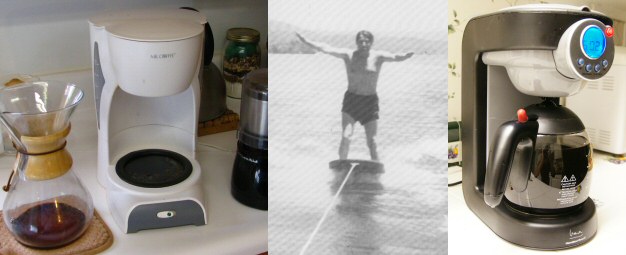
Finally, last Christmas, I forcefully retired the annoying appliance, well before its planned obsolesence, and for the hefty amount of $39.99, turned the stylish Hamilton Beach model pictured above into a lovely Christmas present. Sweet Cheeks has been loving her coffee ever since. As have I. The pot has a plastic spout that is the best I’ve ever used. It pours unerringly, and never drips. The filter stopper works as it should. The water reservoir detaches from the back, meaning it can be filled directly from the faucet, eliminating the step of filling the pot and then having to pour the water into the machine. And the coffee comes out of the thing in pretty swell condition, too.
Of course, for the best coffee in the world (presuming some nice beans, competently roasted, and freshly ground) you need one of those Chemex pots and the special unbleached filters that are hard to find. I started out with a two cup model back in the 1970s, when we’d make coffee so strong we’d get high as kites, painstakingly making tiny pot after tiny pot. The six (seen above) and eight cup models produce an equally resplendent liquor that never fails to impress the uninitiated.
And that’s my story.