
March 21, 2010
Thugs and Thieves
Someone under another of Ezra Klein's disgraceful entries into the record just had to chortle:
msoja, so how does it feel to have exactly ZERO representation in congress?
That's the same thing it was about lo those many years ago, wasn't it? I only had a short answer:
I suppose it feels like it felt to Paine, Jefferson, Revere, Henry, etc.
The government they sought to institute was meant to protect the rights of everyone, not just those who could muster a political majority. We are now back to square one, as far as I'm concerned. Anything is now possible, and the road runs straight down hill.
That person is now "very entertain[ed]" at my disillusionment. Unbelievable.
March 17, 2010
Health care failure roundup
What a mess things are, no?
Mitt Romney is a world class moron, and should be laughed back to Mormon, or wherever it is he's from. He's been lying about his Massachusetts Miracle since before it became the law of that small commieweal. It destroys any of his bona fides, and ought to destroy him. God help us.
Vandam got my Irish up this morning with two links on the RomneyCare failure, one Mark Steyn, and a good article for once in the Wall Street Journal.
Does Romney have less shame than Sharpton?
In the spirit of augmentation, I'll throw in a link (and close an eleven day old browser tab) that assays the snake wrestling between the Massachusetts insurers and government:
“Rushing into this could be perceived as putting price controls on health costs rather than making decisions based on sound actuarial data," said Blue Cross-Blue Shield vice president Jay McQuaide, who blamed the increase in premiums mostly on the rise in medical spending. “This would cause significant disruption in the providing of health services."
And, to further muddy the creeping horrors, from the other end of the country comes, "Walgreens: no new Medicaid patients as of April 16":
Pharmacies that continue to fill Medicaid prescriptions at the current state reimbursement rate are "at risk of putting themselves out of business altogether"
Socialism is a beautiful thing.
February 17, 2010
It’s simple, really
Nothing is ever going to improve in health care costs until individuals take more responsibility for the cost-benefit tradeoffs of the services they receive.
February 9, 2010
Government health care
[T]he congressman's large intestine was damaged during gallbladder surgery and the complications led him to be hospitalized.
[…]
The gallbladder surgery was performed days earlier at the National Naval Medical Center in Bethesda, Md.
Hey, maybe the taxpayers aren't sacrificing enough, yet. Maybe they just didn't care enough about John Murtha. Maybe they should be punished for his poor treatment at their hands.
ps. That's some pretty snazzy writing coming out of Foxnews, no?
February 3, 2010
Don’t fear the Canadian Reaper
The Premier of Newfoundland has flown to sunnier health care climes (i.e. the U.S.):
The Premier whose heart clearly belongs to Newfoundland is having his heart repaired south of the border, making Mr. Williams an exhibit for private American health care advocates seeking to demonize Canada's publicly funded system.
Move over Shona Holmes. You're second-rate propaganda material now.
The Ontario woman was the original star of Canadian health care bashing last year, heavily commercialized by those attacking proposed Obama health reforms in the U.S. after bailing off a long Ontario wait list to pay $100,000 for private brain surgery at the Mayo Clinic in Arizona.
But to have a popular Canadian premier flee to an undisclosed location in the United States for up to 12 weeks of treatment, leaving his stand-in deputy to deliver a less-than-detailed explanation, well, that's quite a step up for U.S. opponents of socialized medicare.
There'll be no quibble from me if Canadians want to buy themselves faster, better treatment south of the border. If you have the cash, picking up your hospital-bound boarding pass will only shorten our wait-lists.
Former MP Belinda Stronach, a breast cancer survivor, bravely admitted she'd gone south because California doctors offered her a superior breast reconstruction procedure.
Besides, buying yourself a new hip or joint, faster diagnostic imaging, colonoscopies or a host of cosmetic enhancements are but a private clinic booking away in several provinces.
While this is admittedly speculative, it's entirely possible the wealthy Williams could not get the required heart procedure done by surgeons on The Rock.
Realizing he'd cause a media circus by shifting to a hospital in another province, he may have decided U.S. health care was preferable to the political fallout of displacing another province's patient on a urgent-care wait-list.
It's also worth noting that Newfoundland does appear, according to Canadian Institute for Health Information, to have the longest cardiac care wait-lists in the country. It shows that 95% of its bypass patients are operated on within 182 days of the go-ahead decision, but that's a far cry from the seven-day average on Alberta's wait-list.
That's cute, innit? The more people who fly to the U.S. for its life saving procedures, the shorter the Canadian waiting lists. By golly, we got to get ourselves some of that.
January 29, 2010
Nine cheeseburgers
Below is a side by side hack of the before and after CT scans of Grace's spine. They're a little different than x-rays, as they show a slice of things at a certain depth rather than the shadow of entire structures, therefore some apparently disconnected parts may actually be connected at points at different depths than those shown. In any event, the shattered vertebra is plainly visible, and, on the right, some of the remedial superstructure thrown into place to compensate. OUCH!
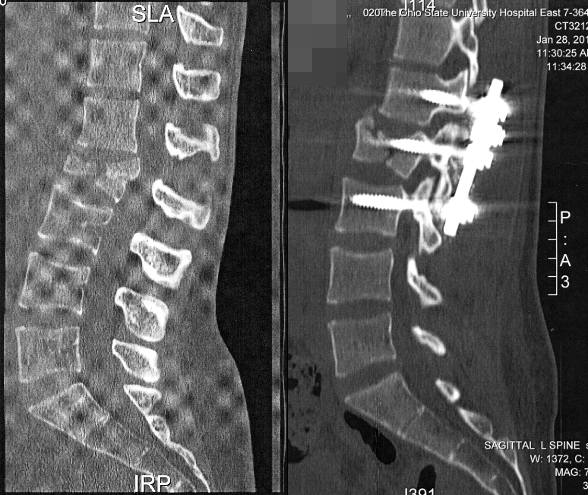
Grace is now reclining, apparently comfortably, in a nearby chair. We were going to go fetch her today, but the threats of incoming inclement weather prompted us to organize a day early, so we enjoyed the fifteen and a half hours of the up and back run yesterday. And it's a good thing we did, as the snow has been coming down all over southern Kentucky and Tennessee for a while. Last night everything was clear and dry, and the big flying moon helped light the roads, thereby reducing the paranoia over lurking herds of deer (I spotted only two carcasses as we flew back south.) The title of the post is what I ate on the trip. Six of those babies were from White Castle, but still, it counts as a personal best.
January 25, 2010
That’s gonna leave a scar
Gracie's back:
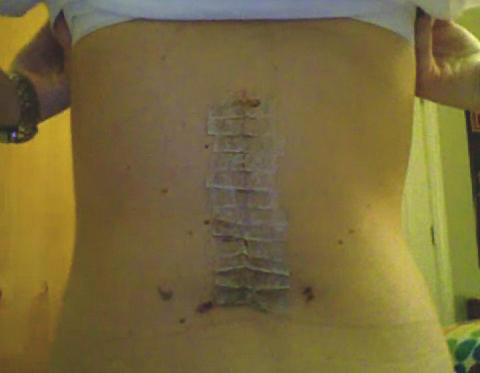
Pic is a few days old, and came in the long way around. Sweet Cheeks took a software snapshot during a Skype session, and emailed the pic back to Grace, who hadn't seen her own back, yet, and was slightly disturbed by the image. And then it was emailed over to this desk.
Ain't technology grand?
The way it was explained to me, the doc went in where you see, but repaired the spine by reaching around it. Really astounding what they can do these days, and so lucky for those living in these times. The dots on either side at the low end are where the drains were.
January 19, 2010
Klein Boggle – Little Big Lies
A Klein Boggle is a certain non-orientable argument, i.e., a contention (a one-dimensional manifest) with no distinct "logical" and "reasonable" sides.
My newshounding has been lackadaisical of late, but I did manage to stop by the Post's Ezra Klein corner today, to find the dear girl still practicing the art of the big lie, to the usual acclaim of his dutifully credulous readers. Here 'tis (with Klein's link to the PDF study):
I get the sense that some Democrats in Congress could use a refresher on the stakes in health-care reform. According to a study conducted by researchers at Harvard Medical School, 45,000 people die a year because they lack health insurance.
He's told the "45,000 people die" lie several times. He's been repeatedly told that it is a lie, and he continues to tell it, anyway. I'm not aware that Klein even grants any sort of controversy with respect to the matter, which, one would think, an avowed health care policy expert ought to be able to take in stride, especially if he truly thinks he's on the right side of it.
But, of course, Klein is not on the right side of the erstwhile health care debate. As many have pointed out, the study that grants Klein and others their plausible denialability was baldly flawed in its methodologies.
Here are some of the critiques of the study, in no particular order…
David Dranove, a pro-reform academic type:
[T]he Harvard study uses a methodology that is inherently biased. (Note to the authors of the study: I did not say that you were inherently biased. I said that your methodology is biased. On the off chance that you see this blog and care to respond, let’s keep the discussion centered on methodology. I have had enough of your personal attacks.)
Now I have to get a bit technical. In regression and related analyses, a critical assumption is that the unobservable characteristics of the “control” and “experimental” groups are uncorrelated with the observables. Translation in this case – if the regression model does not include all possible factors that might predict mortality, and just one of these omitted factors is correlated with insurance status, then the reported coefficient on insurance status is biased. This is an onerous requirement for sure, but it must be met if bias is to be avoided. Without this full set of variables, and in the absence of a randomized experimental design, it is still possible to avoid bias by using advanced statistical techniques such as “instrumental variables” regression. But the Harvard study does not use this technique.
The implication is that their results are biased. We can even guess at the direction of the bias. They started with a few control variables and the estimated impact of being uninsured was much bigger than 44,000 lives lost. When they added additional control variables, the estimated impact fell. It is plausible to suppose that with additional controls, the estimated impact would shrink further, perhaps to the point of statistical insignificance. I don’t know that for sure. No one does.
David Hogberg at Investor's Business Daily:
Two of the authors, the husband and wife team of David Himmelstein and Steffie Woolhandler, are co-founders of the single-payer advocacy group Physicians for a National Health Plan. But even if they were completely disinterested researchers, the article cannot reliably link insurance status to mortality. The article itself says so:
Our study has several limitations. NHANES III assessed health insurance at a single point in time and did not validate self-reported insurance status. We were unable to measure the effect of gaining or losing coverage after the interview.
In other words, the researchers had no idea if respondents who were uninsured in 1993-1994 remained uninsured through the time that they died, or if they obtained insurance coverage during that time. (They also don’t know if respondents insured in 1993-1994 later lost insurance.)
Thus, it’s quite possible that the people who were uninsured in 1993-1994 and had died by 2000 may have had insurance and, presumably, greater access to health care sometime between 1993-1994 and their time of death. To put it gently, that’s a pretty serious flaw.
The authors follow that passage with this lame defense: “Point-in-time uninsurance is associated with subsequent uninsurance.” In other words, if you are uninsured at one point in time there is a reasonable likelihood that you will be insured later on.
To support that sentence, the authors cite a study in the journal Health Affairs titled “Health Insurance Coverage And Mortality Among The Near-Elderly.” This study examined insurance status of people aged 55-64 in 1992 and its effect on mortality through 2000. And this study did examine the insurance status of those uninsured in 1992 through subsequent surveys. But this is what the study found:
Among adults who were uninsured in 1992, the proportion of respondents who reported being publicly or privately insured rose progressively in the ensuing four surveys (46.6 percent, 58.4 percent, 66.1 percent, and 74.5 percent), as nearly half reached age sixty-five and became eligible for Medicare by 2000.
Thus, people who are uninsured at one point in time are more likely to be insured in subsequent years. It would be more accurate to say: “Point-in-time uninsurance is associated with a subsequent increase in insurance coverage.” Doing that, however, would have only widened the gaping hole in the research behind the “45,000” statistic.
Randall Hoven at American Thinker, in parallel with the folks at Harvard, concludes that voting Democrat causes cancer:
By applying the same logic in interpreting both studies, three times as many lives could be saved by no one voting Democrat as by providing universal health insurance.
Michelle Malkin caught the fever:
How did these political doctors come up with the 44,000 figure? They used data from a health survey conducted between 1988 and 1994. The questionnaires asked a sample of 9,000 participants whether they were insured and how they rated their own health. The federal Centers for Disease Control tracked the deaths of people in the sample group through the year 2000. Himmelstein, Woolhandler and company then crunched the numbers and attributed deaths to lack of health insurance for all the participants who initially self-reported that they had no insurance and then died for any reason over the 12-year tracking period.
At no time did the original researchers or the single-payer activists who piggy-backed off their data ever verify whether the supposed casualties of America's callous health care system had insurance or not. In fact, here is what the report actually says:
"Our study has several limitations," the authors concede. The survey data they used "assessed health insurance at a single point in time and did not validate self-reported insurance status. We were unable to measure the effect of gaining or losing coverage after the interview." Himmelstein et al. simply assumed that point-in-time uninsurance translates into perpetual uninsurance—and that any health calamities that result can and must be blamed on being uninsured.
Another caveat you won't see on Grayson's memorial to the dubious dead: The single-payer advocate-authors also conceded in their study limitations section that "earlier population-based surveys that did validate insurance status found that between 7 percent and 11 percent of those initially recorded as being uninsured were misclassified. If present, such misclassification might dilute the true effect of uninsurance in our sample."
Media Matters pretends to rebut Malkin, but completely ignore the study author's own admission of the study's "several limitations".
Someone at FactCheck.org was warily honest:
Now, on to the tough question: Is the 45,000 figure accurate? We can’t say for sure, but […]
… and…
There has been some criticism of this type of research and its ability to find a direct causal link. A 2003 commentary by Richard Kronick in Medical Care Research and Review questioned whether other factors beyond uninsurance would reduce the greater mortality for the uninsured. Kronick recreated the Franks study using more recent data and, after adjusting for various factors, also found a 25 percent greater risk of death for the uninsured. But he said: "It seems likely that if we were able to control for additional factors, such as health-related behaviors (smoking, alcohol consumption, obesity, and risk-taking behaviors more generally), wealth, or value placed on health or health care, the estimated effect of being uninsured would be reduced further. What is uncertain is whether the reduction would bring the estimated hazard ratio all the way down to 1.0 or whether an independent effect of being uninsured would remain." (Other studies, including the Franks study, did adjust for smoking, alcohol consumption, obesity and income.)
Another recent report, written by former Congressional Budget Office Director June O’Neill and her husband, economist Dave O’Neill, said "that lack of health insurance is not likely to be the major factor causing higher mortality rates among the uninsured. The uninsured — particularly the involuntarily uninsured — have multiple disadvantages that in themselves are associated with poor health." Those disadvantages include education level and income. The O’Neills’ study, published by the conservative Employment Policies Institute, separated those it deemed "voluntarily uninsured" (anyone earning 2.5 times the poverty level) from those considered to be "involuntarily uninsured." The study looked at data on persons aged 51 to 61 from the Health and Retirement Survey and determined the "involuntarily uninsured" had an 11 percent higher probability of dying; the number dropped to 3 percent when controlling for smoking as well as education and income. The “voluntarily uninsured” had a 2 percent to 3 percent greater probability of dying. EPI, the publisher of the study, supports business interests and has said that the “living wage campaign” is “an organized effort to force employees to inject a welfare mentality into the workplace.”
Carl at NoOilForPacificsts is not be left out and provides a multitude of links:
[T]he study's methodology obviously is flawed. The paper uses survey data gathered between 1988 and 1994 by the National Center for Health Statistics (NCHS). About 34,000 people were interviewed about various health-related characteristics, including whether they were insured. The authors then excluded those over 64 (virtually of of whom are covered by medicare) and children under 17. They also excluded non-elderly already covered by Medicare, Medicaid or VA health insurance, because "a substantial proportion of those individuals had poor health status as a prerequisite for coverage." The researchers also culled those with missing or incomplete interview data. The resulting relevant population was 9,004 surveyed individuals, of which about 84 percent were listed as insured while the remaining 16 percent were not. In a 2000 follow-up of the 9,004 individuals, 351 (or 3.1 %) had died. Then, for the most part, they assumed that mortality among the uninsured was caused by the lack of health insurance. This is nonsense, for three reasons:
First, demographics matter:
People with insurance tend to be healthier, wealthier, wiser and more gainfully employed than people without insurance.
So you can't blame their longer lives only on their insurance.
To be sure, the study acknowledges several other factors contributing to mortality, such as "gender, age, race/ethnicity, poverty income ratio, education, unemployment, smoking, regular alcohol use, [sub-standard] self-rated health, [and sub-standard] physician-rated health." But, because they found "no significant interactions" between the lack of insurance and those other variables, the authors downplay those factors.
Second, there's scant causal connection. The lack of health insurance isn't static–over 80 percent of the uninsured regain coverage within two years. And one can't assume deaths were due to any lack of health care–after all, bad health care also can be fatal. Yet the study presumes lack of health insurance is among the causes. As John Goodman, president of the National Center for Policy Analysis notes:
The subjects were interviewed only once and the study tries to link their insurance status at that time to mortality a decade later. Yet over the period, the authors have no idea whether subjects were insured or uninsured, what kind of medical care they received, or even cause of death.
And the study itself concedes that "between 7% and 11% of those initially recorded as being uninsured were misclassified," raising questions about the sample's accuracy.
Third, other research is to the contrary. For example, a study by UCSD prof Richard Kronick, Ph.D., found:
Adjusted for demographic, health status, and health behavior characteristics, the risk of subsequent mortality is no different for uninsured respondents than for those covered by employer-sponsored group insurance at baseline.
Further, a June 2009 report by Drs. June and David O’Neill of Baruch College found the differential mortality between insured and uninsured to be of questionable statistical significance, and in any event only about 3 percent when comparing the insured with the voluntarily uninsured. Overall, they conclude:
a lack of health insurance is not likely to be the major factor causing higher mortality rates among the uninsured. The uninsured–particularly the involuntarily uninsured–have multiple disadvantages that are associated with poor health.
Conclusion: I've always supported a tax-funded safety net for the poor, including for those who can't afford health insurance. But rejecting phony scare stories is crucial for assessing the scope of the actual problem and crafting the appropriate policy remedy.
And there you have it. It took me about five times longer to copy and paste it all than it took to Clusty it all up, so how come a guy whose business it is to know this stuff pretends it all doesn't exist?
The more I read Klein and get to know how he responds to the challenges put to him, the more I have to conclude that Ezra Klein is a Quisling and a liar. Look at his reaction to Grubergate (I only had time for a short comment there, but others made points, fazing Klein not a whit.)
How some people can live with themselves, I don't know.
January 8, 2010
Too unbelievable?
I'm thinking of writing a screen play. But I heard that there's a lot of work involved, so I thought I'd run it by you to see if maybe I'm overly blinded by my own certainty on the matter before I go to a lot of trouble for nothing.
Here's the basic story line…
Two healthy, fit, early-twenty something college students, one of each sex, heck, let's make them brother and sister, decide to go snowboarding one brightly frigid winter day like they have every winter for several years. They have fun. They make several runs, working up to harder, more challenging slopes.
They begin a new run, one slightly ahead of the other, down a particularly challenging section. The girl misjudges her speed or the height of the next mogul and falls. There is pain. Farther down the slope, the same thing happens to the boy, and he lies there in the frozen snow. Time passes. Eventually, paramedics arrive, confronted with two separate incidents. Answering questions the girls says her brother is there somewhere, but doesn't know where he is. The boy tells those attending him that he was snowboarding with his sister, but doesn't know where she is. Both are completely immobilized and transported separately to a nearby hospital. They meet, once again, in the emergency room.
How am I doing so far? Try to imagine more character development leading up to all that, you know, to snag your emotional involvement.
Of course, as you may have guessed, there's no screen play. The two kids are Kathy's. Her only kids. The phone calls started coming in just after midnight, last Saturday night/Sunday morning. There was at first a great deal of vagueness, part of it caused by horrible intermittent connections. All we knew was that the kids were hurt but alive, and one or both of them were being transferred to the Ohio State University Medical Center, about an hour down the road. It wasn't until about three in the morning that we had a better picture of things.
Tom had cracked a vertebrae in his neck, with some possible attendant damage to ligaments or tendons, and had possibly sustained damage to his lower back, but could wiggle his toes and fingers and would eventually once again be hale and hearty. Grace had buggered one of the vertebrae in her lower back, but likewise, could wiggle things.
Needless to say, we didn't get much sleep. Kathy was on up the road in the morning, packed for an extended stay, and not knowing what might develop during her seven hour trip.
To make the story short, things were both worse and better than we knew. Both kids underwent extended surgery Monday. The doctor told Tom there was a 70% chance of success, with the other 30% encompassing some variety of partial or complete paralysis along with the cheerful option of death. Tom was suitably impressed with the doctor's frankness. There were a number of concerns. No one gave Grace a set of odds, but apparently, her prognosis was even more dicey. As it went, both surgeries went exceedingly well. No one died. No one is going to be paralyzed. Never has there been so much crying and laughing mixed together. Apparently, the smile on Tom's face when he realized that he hadn't woken up dead was something to see.
Tom was released from the hospital yesterday. Kathy joked, "Break your neck on Saturday. Go home on Thursday." He'll even be able to return to school when it starts up next week or so. He'll be in a big brace for months, but should be able to take care of himself.
Grace is progressing more slowly. One vertebrae was completely shattered. I don't know how they fixed it. She walked yesterday, but is having trouble with nausea. She's going to miss school this quarter, and, as a 4.0 plus student in the honors program at Ohio State, she's not happy about it. And she'll be in a full body brace for a while. She may get out of the hospital Sunday.
Kathy is holding up well, but has had the wild ride only a mother can know. This whole thing has made everyone appreciate how precious we are to each other. I can't wait until my wife is back home.
We hope the rest of the year is relatively unexciting.
December 31, 2009
Get used to it
There's so much horrible news sloshing back and forth, and with such velocity, that it's nigh impossible to pick a spot to jump in, and why bother at this point (though I might have comments on some of it at some point)?
Still, sometimes a snippet floats past, an aside, sort of, like this:
The Mayo Clinic, praised by President Barack Obama as a national model for efficient health care, will stop accepting Medicare patients as of tomorrow at one of its primary-care clinics in Arizona, saying the U.S. government pays too little.
There is no out from this down. There is no escape from the rubber room of our collective madness. Hang on to the spiral, and follow it in, and hope to swing out the other side.
The last day of the year.
December 19, 2009
“Now the sun’s gone to hell”
It's getting dark in America. Forced health insurance. And government control of every aspect of it. It's something new.
Now all I have to do is sit here, and refuse to buy the state's product (or its facsimile), and they'll come after me.
And that's the way it's going to be.
It's not war by another name, now.
December 11, 2009
Who is responsible for your confusion?
That's what I'm wondering after reading an article titled, Who is responsible for your life?
I had high hopes for the thing. There are overtones of sensibility in it. It refers to "the socialists in Congress". At one point the author states:
If you follow unhealthy habits, you have no right to ask fellow employees to subsidize your life style.
Well, of course, right?
But then the same guy immediately proceeds to collapse into his own busybody, authoritative notions of what constitutes the right kind of health care system. Everything he mentions is couched in terms of government doing something:
On the cost side, eliminate the $4.7 billion spending yearly on direct to consumer drug advertising. This only drives up the cost of prescriptions. Allow for tort reform thus ending a $54 billion waste in liability costs, court time and excessive medical costs. In 2008, according to Business Week, the “consultant firm McKinsey found $650 billion in excess medical costs, even after adjusting for the fact that rich nations spend more of their incomes on health.” A Forbes article entitled Useless Medicine covered unnecessary procedures in stents, mental health, back pain, arthroscopy in arthritis, fainting, spells and imaging.
In other words, people and businesses are still able to act in ways that do not comport with one editorialist's vision, to the alleged detriment of the collective, and there ought to be a law!
The author, under the rubric of claiming responsibility of his own life, can't quite grasp that others are entitled likewise, whether they allegedly waste their own money on advertising or not.
It's not helpful.
November 28, 2009
The government wrecking ball
Out of the dinsome effervescences of the endless inanities comes a single clear explanation of the flu vaccine shortage:
The 1993 Vaccines for Children program gave the Centers for Disease Control power to set the price for childhood vaccines. In the 1990s, it paid as little as 25 percent of the list price, according to a 2003 study by the Institute of Medicine (IOM), a branch of the National Academies of Science.
That led a number of firms to stop making vaccines; those remaining did not invest in new technology. The IOM study said, "The desire to maximize short-term savings in purchasing current vaccine products … is directly opposed to the goal of creating financial incentives" for commercial firms to make and improve vaccines.There is at present only one flu vaccine manufacturer in the United States, and it uses a 50-year-old chicken-egg technology that often fails. In 1996 there were eight U.S. vaccine manufacturers.
Vaccine shortages were so prevalent in the years between 2000 and 2005 that they became an issue during the 2004 presidential campaign. In 2005 Congress gave President George W. Bush $7.1 billion to develop a vaccine production base and stockpile other medicines to meet the demands of pandemic flu.
The government gave contracts to six firms to build U.S. plants to produce vaccines using a new cell-based technology. But the plants will not come on line until 2012 or later. Because of the withered size of the vaccine industry, gearing up for a pandemic has already cost billions in public subsidies and will cost more in the future.
Meanwhile, vaccine prices charged by the small number of active suppliers to the market have risen sharply between 2004 and today.
Could those problems be repeated on a larger scale? Congress reportedly is considering forcing the pharmaceutical industry to reduce its prices. The New York Times recently reported that drug companies are raising prices in possible anticipation.
There you have it. Do you really need to know any more?
November 18, 2009
Why do I put myself through this?
I may give up reading the news, folks. The sheer number of ignoramuses spouting off out there is … disheartening. They're everywhere. Everywhere. All the time. My windows fill up with stupidities, and then I close 'em down for lack of time, or the dead feeling of wasted effort chronicling someone else's wasted effort and thought.
Washington defends nationwide shortage of swine flu vaccine
Wow, I thought, that's going to be some good sarcasm.
But there's none there. It's not meant to be sarcastic. No irony is implied, or seen. There's no snark. The story is nothing but wasted prattling, filled with hints of a truth that's never recognized. In other words, just plain dumb, and revealingly so.
Here's an expanded slice:
Reasons for the swine flu vaccine shortage
There are a number of explanations for the swine flu vaccine shortage according to federal officials.
Why is it one puts one's faith in explanations given by the very people perpetrating the failure? Politicians and bureaucrats are never going to impugn themselves on any matter of substance. They are masters at finger pointing. Masters of demagoguery, and of turning questions aside, and any of the other arts of the con man.
First, the vaccine production method is not fast enough, viruses did not grow as quickly as expected in some cases, and the egg-based virus harvesting methods are apparently outdated. The government has in fact given $1.3 billion to vaccine makers to develop more efficient methods. So far, methods such as using mammal cell broths have been developed, but not approved.
So, I guess manufacturers are forced to use "outdated" methods, because approval for the new methods are caught in some governmental regulatory choke point. Whose fault is that? And after one has given $1.3 billion of other people's money away for the purpose of improving on the old, outdated methods, how can one be surprised at the well-known shortcomings of those old, outdated methods? Which bureaucrats and politicians expected more than they got? All of them? Or just the ones whose faith in government subsidies is unshakeable?
Also, the government complains that most of the factories are located outside of the United States, slowing down the process even more. They argue that this is a good reason to develop state-of-the-art manufacturing plants in the United States.If the swine flu is going to be a regular addition to the season flu every year, and shortages are going to be a running theme in the public health care system, the federal government can easily justify building US-based factories.
That whole thing just boggles. Why are almost all the factories in foreign lands, does the author consider? Were they driven there by onerous and ignorant government regulations, and by a customer (also the government) who insisted (and I do mean insisted in its most sinister sense) on prices so low as to be, in the parlance, unsustainable? And now that private enterprise has been driven to foreign shores, or just plain wiped out with government interference, why, "the federal government can easily justify building US-based factories". And won't they be the models of enterprise?
The third issue is control. The federal government did not take complete control of swine flu vaccine distribution, leaving local health officials to distribute vaccines. Many people in the high-risk populations have had trouble, or have not received the swine flu shot at all in certain regions of the country.
That boggles, too, as I've not heard of vaccine being sent out from the CDC's distribution warehouses and not making it to its appointed destination. And I've been keeping tabs on it. What does the person think she's talking about? It's nonsense. There's been no failure to deliver at the local level. The failure has all been with the feds, beginning with the socialization of the vaccine markets decades ago, and continuing with incompetent regulation, tortoise-like approval, and inept, top down, command and control execution. And few have the brains to see it, but are still willing to prattle on as if they do.
Ieeeeeeeeeeeeeeeeeeeeeeeeeeeeeeeeeeeeeeee!!!!!!!!!!!!!!!!!!!!
November 17, 2009
Double D Death Panels
The government weighs the cost of your life:
[T]hese new guidelines capture 81 percent of mammography's benefits, save a lot of resources, with only a 3 percent drop in survivorship from the most common cancer to affect women
Only a three percent drop in survivorship. !
Perry Eidelbus dissects the horror of it. He calls it Deathcare, and that's exactly what it is.
November 15, 2009
Massachusetts miracle elixir looking more and more like drain cleaner
A couple stories to strike terror into the bleeding hearts of incompetent socialists here and there.
Emergency room visits, the very thing the goofballs wanted to cut down, are up in the Bay State:
Massachusetts passed a law in 2006 that has increased the percentage of insured to 97.4 percent of its population, the highest in the U.S., from 93.6 percent.
Waiting Times Rise
The average waiting time to see a family-medicine doctor in Boston, a city with 14 teaching hospitals, is 63 days, the most among 15 cities in a 2009 survey by Merritt Hawkins & Associates, a recruiting and research firm in Irving, Texas. People in Los Angeles waited 59 days, while those in Miami saw doctors in 7 days, the survey found.
Boston’s longer wait was “driven in part by the health- care reform initiative,” the report said.
Even before the initiative, there was a shortage of primary care doctors in Massachusetts, said Harvard’s Goroll, who is also an internist at Massachusetts General Hospital in Boston. As many as half of doctors in the state have closed their practices to new patients, forcing many of the newly insured to turn to emergency rooms for care, he said.
And all those doctors NOT taking new patients. There should be a law…
And on the political front, where Massachusetts' health care future is in good hands:
More than a million low-income Massachusetts residents covered by Medicaid would be required to pay more for visits to certain doctors and receive prior approval for some expensive psychiatric medications under a plan announced yesterday by the Patrick administration to narrow a $307 million shortfall in the state’s MassHealth program.
Some of the biggest changes are in dental care for adults, who would no longer receive dentures or other oral care except for cleanings, X-rays, and emergency services.
That change alone is expected to save about $15 million this fiscal year, said interim Medicaid director Terence Dougherty.
Under the proposals, the state will also stop paying for personal care attendants for patients requiring the in-home aides less than 15 hours a week.
Hey, that's not so bad, is it? I mean, it's not death panels. People can live without teeth, right?
Don't worry.
You know it’s a boondoggle half way through the first sentence
Steve Lohr writes what he's told at the New York Times, and misses the obvious:
The nation is set to begin an ambitious program, backed by $19 billion in government incentives, to accelerate the adoption of computerized patient records in doctors’ offices and hospitals, replacing ink and paper. There is wide agreement that the conversion will bring better care and lower costs, saving the American health care system up to $100 billion a year by some estimates.
But a new study comparing 3,000 hospitals at various stages in the adoption of computerized health records has found little difference in the cost and quality of care.
Steve, do you think doctors and hospitals would need "government incentives" if your alleged "wide spread agreement" had the germ of a nut of truth in it?
Or don't you care, because if the government weren't running another $19 billion racket through the pipe, you'd have to find something else to write about?
More flu shot idiocy
An editorial in the Toledo Blade:
IT'S a good thing that no one from modern Wall Street was on the Titanic when it slammed into the iceberg. As the freezing waters rose, the women and children would have had to line up behind the most well-connected tycoons for a place in the lifeboats.
Nothing symbolizes the fiasco that has been the distribution of the H1N1 flu vaccine better than news that Wall Street firms like Citigroup and Goldman Sachs are receiving supplies of the vaccine before the rest of the public.
You don't have to be a populist to be disgusted by the news. One would have expected preferential treatment of the powerful and connected during the Bush years, but the fact that this is happening during President Obama's watch is beyond galling.
I shake my head, sadly, for what people have become.
I've commented, previously, on the current vaccine delivery protocol that the unnamed editorialist above is so wound up about, and I think my point is valid, obviously.
Invoking the Titanic is ludicrous. A ship's passengers and crew are but a teensy, tiny, almost infinitesimal subset of the larger population, and the particular demographics of the survivors will have relatively little impact upon the comings and goings of the greater masses on shore. And so there are protocols built out of common courtesies, as well of certain practicalities having to do with efficiency, order, and the ability of those who must contend for survival of a more arduous nature.
But in the aftermath of a truly grave pandemic, one does not want to wind up with a world populated solely with pregnant women, children, other at-risk individuals, health care workers, and self-serving politicians, does one? Well, maybe the politicians would like it, but it still wouldn't work very well.
No, instead of gibbering about the Titanic, one might more handily refer to Noah, and the Great Flood. You know the one. With the Ark. Noah didn't say, "Uh, only pregnant women and children, and health care workers," because that would have been stupid. Noah wanted a cross section of everyone, because that's what you need to build a civilization on the other side.
And the best way to hand out vaccine to a very large cross section of the population is to let those who can buy it, do so. And, if someone wants to buy extra doses and dole them out amongst poor people, let 'em. See my post just previous to this one for more.
The notion that government should determine who has access to life saving medicines is utter madness, and another glaring failure of public and private perception.
One step forward, two steps back
I've linked to several older articles pertaining to the way government has killed the free market vaccine manufacturing industry, but they're few and far between, even as two current flu vaccine shortages have various people asking a lot of uncomfortable questions. Unfortunately, a lot of people are asking the wrong questions, or promoting an uninformed view, or pointing fingers for political reasons claiming the answer is, as usual, more government intervention.
It was with surprise, then, that I stumbled upon the following in Canada's National Post:
It’s a bit counterintuitive, but really it’s because we’re unwilling to allow a price tag to be put on the H1N1 vaccine — because we see it as too important to be left to the vagaries of the market — that we’re seeing such unequal access to it.
Imagine if pharmaceutical companies were free to produce an H1N1 vaccine any way they saw fit and were allowed to charge people what ever they wanted for it. Given such an incentive, the pharmaceutical companies would quickly move from growing the vaccine in hens' eggs (which risk-averse government health agencies favour, but significantly slows down the process) to growing the vaccine in monkey cells, or to other faster methods.
The shortages would be a thing of the past, and no longer would being a celebrity or having an old university roommate who’s now a doctor be necessary prerequisites for getting access to the vaccine. Yes, you'd need money to get your hands on the shot. But as imperfect scenarios go, discrimination based on cash — rather than class or connections or social status or education or blood ties or the ability to pilot a puck around the ice — is probably the least dangerous inequity there is.
Pretty much right on, with only a few quibble-ables at the fringes. You may read the whole thing, if you like. The refreshing message is: let the free market do what it does best.
Unfortunately, what passes for the news is filled with less perspicacious fare.
For an example of blatant nonsense, there's the World Socialist Web Site:
President Obama determined that the best approach to the swine flu would be provided by “market solutions.” The White House entrusted production of the vaccine to a handful of pharmaceuticals (none of which are US-based firms, which find the production of flu vaccines insufficiently profitable.)
They go on to blame Obama for not being a better miracle worker, not understanding that having the government dictate prices, quantities, and a raft of regulations as sole purchaser of a couple hundred million doses, means there are no "market solutions" lurking anywhere near the thing. Government's decades long involvement in the vaccine business has driven almost all competitors from the field. That the few businesses capable of fulfilling orders of such magnitude ply other areas of their trade in the free market is immaterial. The "handful of pharmaceuticals" that the government has contracted with are the only ones left in the world willing to do business on the government's terms. The rest, and there used to be dozens, couldn't hack it, didn't want the endless hassle for relatively little profit, and closed up shop, driven out of the market, not by competition, but by an overbearing buyer who made doing business untenable. The stupid WSWS sneers with its "insufficiently profitable", but doesn't bother to wonder just who it was that insisted, over the course of a decade and a half, that vaccine production be something less than sufficiently profitable. It was stupid socialists in stupid government.
Then there is the simply inane crap thrown around as part of the usual political food fight. Here's the incompetent Media Matters trying to score points against the fool Sean Hannity:
Sean Hannity blamed the H1N1 vaccine shortage on the government and suggested that the shortage is indicative of the government's ability to reform health care.
[…]
Fact: CDC, Sebelius say private sector manufacturers' projections of available vaccines were too high.
Well, Hannity is still correct, even if he doesn't exactly know why (or maybe he does, I don't listen to or watch him), for all the reasons given higher up in this post. But Media Matters is doubly ridiculous for suggesting that erroneous projections are the cause of the shortage. Had the pharmaceuticals correctly predicted the manufacturing bottlenecks and low yields, there would still be a shortage. It just wouldn't have surprised anyone (not that anyone closely watching would have been surprised, anyway). The current swine flu vaccine has never been made before. No one knew for sure how it would go. It's not Obama's fault, per se, and it's not GlaxoSmithKline's, either. It's the nature of the business. Media Matters and the government are assigning blame for things that no one could have predicted, all the while completely missing the larger point about having all one's eggs in the government held basket. It is government's fault that there is a shortage of vaccine, but it's not because someone or other couldn't accurately predict the future, it's that there are so few players in the game, the most competent of them having decided it wasn't worth their time, effort, and investment to do the government's bidding. It is government's fault (and here, Obama is to blame) for thinking that one can order up a couple hundred million doses of something that has never been manufactured before, and that there won't be any problems, matched with the other utter failure in not recognizing that flu vaccine production is exactly the kind of thing that the free market excels at.
But there it is. One good article on the subject out of weeks and weeks of mindless drivel pushing sense out of the discourse. God help us all.
November 11, 2009
Duh, where’d all the vaccines go?
No one has a clue, you know. It’s that… that… bottle necks in production thing, innit?
U.S. blames drugmakers for slow flu shots
November 11, 2009 — 12:16pm ET | By Tracy Staton
Who’s at fault for the slow-to-market H1N1 vaccine? USA Today asked consumers, and more than half of them blamed drug companies. Some 62 percent said they blame pharma either a great deal or moderately. The government, by contrast, got 58 percent of the blame.
We all know why vaccine production was slow off the starting blocks. The first seed strain of the H1N1 virus didn’t multiply as fast as the usual seasonal flu strains, setting vaccine makers back. Since then, the companies have been able to amp up production. And they’ve been shouting that news from the rooftops. Most recently, it was Sanofi-Aventis CEO Chris Viehbacher (photo) who said that U.S. production had hit optimal speed.
But vaccine makers still haven’t caught up with promised delivery volumes. Some 41 million doses are available as of today, FDA Commissioner Margaret Hamburg said in a letter to doctors.
Plus, the U.S. didn’t embrace new vaccine technology that could have sped up production, namely, adjuvants. These shot-boosters allow vaccine makers to produce more doses with less actual virus. The only company producing an adjuvanted flu vaccine for the U.S., GlaxoSmithKline, has just now won FDA approval.
Yadda yadda.
And that’s what people SEE. "Gosh, the gummint ordered a bunch, but the danged manufactors had bottlenecks."
What people apparently DON’T see are all the vaccine makers driven out of the business by various government intrusions into the vaccine marketplace over the last two decades (and longer).
Here:
In 1993, Hillary Clinton’s Vaccines for Children program was set up to buy children’s vaccines from manufacturers and provide them to Medicaid clients and the uninsured free of charge. To ensure low prices, the program legislation capped the price of the three vaccines then in use.
The price controls did what price controls always do, they created a shortage. As a 2005 Department of Health and Human Services budget brief pointed out, "The price caps [were] so low, however, that the tetanus vaccine was removed from the Vaccines for Children program in 1998 when no vender would bid on the contract."
[…]
By 2002, the VFC program was purchasing slightly more than 40 percent of U.S. pediatric vaccines. Its focus on low prices likely helped destabilize long-term vaccine supplies by eroding profit margins. When profit margins are low, firms move scarce capital to other, more highly valued uses. Production facilities do not get repaired, replaced, or upgraded. When current plant and equipment wear out, producers simply exit the market.
A 2003 report from the Institute of Medicine on vaccine finance reported that the number of vaccine producers licensed for the U.S. market fell from 26 producers in 1967 to four producers in 2002. Factors cited for the decline included more stringent regulation, concerns about tort liability and "poor returns on investment."
In short, the government’s myopic focus on low, low prices likely destroyed the U.S. vaccine industry.
Here:
Nearly a decade ago, a number of us participated in a similar conference at the American Enterprise Institute, focusing on the Clinton Administration’s Vaccines for Children Program. We discussed the impact federalizing nearly 70 percent of the vaccine market would have on the development of new vaccines, and how it would affect the availability of the pediatric vaccines recommended back then. The fact is, we raised the concern that shortages were a potential byproduct and that the Clinton plan was likely to hinder development of new vaccines in the future.
Here we are just a few years later and we are down to four vaccine manufacturers. As demand for vaccines has gone up, the number of suppliers has gone down. We have had product shortages, and we are selling some pediatric vaccines at 15 cents a dose. At the same time, the cost of manufacturing and the cost of compliance with regulation have both gone up.
It takes a little reading between the lines to discover that the FDA was at the heart of the recent vaccine-supply problems. In comments to the media and Congress, government (especially FDA) officials have obscured this truth. Here is a typical statement:
the recent shortages stem from a number of factors including: 1) the withdrawal from the market of one manufacturer, 2) difficulties in the manufacturing process, 3) temporary shutdowns of facilities for upgrades or maintenance, or to correct manufacturing deficiencies observed by the manufacturer or FDA during inspections, and 4) other factors, such as transition to thimerosal-free vaccine formulations. (U.S. Senate 2002a, 1)In the following sections, I show how each of these “factors” can be traced back to the FDA.
Withdrawal from the Market. Most official (especially FDA) statements on the shortages emphasized that some companies left the vaccine business. An FDA press statement on the shortages stated sardonically, “Calling it a business decision, Wyeth Lederle withdrew from the manufacture of DTaP and Td vaccine” (qtd. in Meadows 2002, emphasis added).
The statement fails to mention that Wyeth’s “business decision” came two months after the company had been forced to pay a record $30 million fine under the terms of a CGMP consent decree (“Company News: American Home” 2000; Russell 2002). The decree also forced the company to hire independent inspectors to monitor CGMP compliance at the two plants where violations had been found (in Marietta, Pennsylvania, and in Pearl River, New Jersey). These inspectors were to report directly to the FDA. Any problems they found would have to be fixed on a schedule “approved by FDA.” If the company failed to meet the schedule, it would be forced to pay $15,000 each day it remained in noncompliance, up to a $5 million limit. Despite the steep fine and strict terms, the FDA admitted that it never actually “found contaminated Wyeth products and is aware of no illnesses” resulting from the CGMP violations at the plants in question (U.S. FDA 2000a).
At the same time, a maker of influenza vaccine was jumping through similar FDA hoops. Parkedale Pharmaceuticals was struggling to comply with the terms of its own FDA consent decree. The FDA inspected Parkedale’s influenza vaccine plant in Rochester, Michigan, in October 1999, found a number of CGMP violations, and ordered the company to correct them. Six months later another FDA inspection revealed that the company remained out of compliance. This time the FDA ordered Parkedale to halt production and distribution of its vaccine pending future approval (“FDA Halts” 2000; Miecko 2000b).
A month later Parkedale notified the FDA that it had completed “all actions required by the agency” (King Pharmaceuticals 2000), and the company was allowed to resume manufacturing. FDA monitoring continued. For the next several weeks, Parkedale held “teleconferences” with the FDA and submitted “biweekly written status reports on the corrective actions” it was still taking. Then, on June 9, 2000, Parkedale officials met with officials from the FDA for more discussions. The company said the FDA was “pleased and encouraged by Parkedale’s efforts and progress to date” (qtd. in “Parkedale Pharmaceuticals Meets” 2000).
A few weeks later the FDA conducted another inspection and again ordered a halt to Parkedale’s operations.
That goes on and on.
"The U.S. vaccine system has some good things going for it, but it also has some important deficiencies," said Frank Sloan, a professor of economics at Duke University, who chaired an Institute of Medicine (IOM) committee that in August issued a report, "Financing Vaccines in the 21st Century." The IOM is affiliated with the National Academy of Sciences.
Mr. Sloan said money — notably the low prices the federal government pays for childhood vaccines — is a primary factor in many of the vaccine shortages that have plagued the country.
"We’re using a lot of old vaccines that are very cheap, only a dollar or so a dose," Mr. Sloan said in a telephone interview. "The government tries to get low prices, which discourages research and development [into new vaccines]."
The IOM report found that vaccines are not very important to drug companies financially, because only 1.5 cents per dollar of drug-company revenue comes from vaccines. The report urged that financial incentives be offered to stimulate new vaccine development.
Mr. Sloan said undoubtedly, the low prices paid for vaccines played a role in the manufacturing glitches that, for a time, stalled Wyeth’s production of pneumococcal conjugate vaccine.
"Because of the prices being paid, some firms are not putting enough resources into production," he said.
And few companies are making vaccines these days. In 1967, about 30 U.S. firms manufactured vaccines. But now there are only five, according to the IOM report.
Every one of these articles and reports says the same thing: Government intrusions into the market has killed the vaccine producing industry, but if you can find it being reported on a major media website, or coming out of the mouth of a politician, let me know.
What has happened with vaccines is what everyone should have expected would happen. There’s no mystery to any of it, or, if there is a mystery, it’s the mystery of why politicians whose big idea is to gather every kind of endeavor under government skirts aren’t promptly locked in the stocks and pelted with rotten vegetables until they admit the stupid error of their ways.
Bugs in the system
One wouldn’t know it from the nightly news, but down on the hospital farm, where people have to have money in the bank before they can cash their checks, there is consternation about certain things:
Supposedly, the rest of the country need only look at Massachusetts to witness the nirvana of universal health care. Perhaps they shouldn’t look too closely.
Massachusetts has had universal health care since 2006, thanks to former Republican Gov. Mitt Romney, the late U.S. Sen. Ted Kennedy and the Democratic Legislature. At one level, it looks like a smashing success — according to state officials, nearly 98 percent of the state’s residents have coverage of some kind.
But it is costing more than anyone predicted it would. Since 2006, total health care spending in the state has jumped 28 percent. Insurance premiums have been increasing by 8 percent to 10 percent a year, nearly double the national average.
And while government has always underpaid for Medicaid and Medicare services, letting private insurance premiums make up the difference, it has recently cut reimbursements to hospitals even more. So some cracks are showing.
The Merrimack Valley Hospital in Haverhill is joining five other Massachusetts health care facilities in threatening to sue the state to force it to pay them more. What they have in common is that two-thirds or more of their patients are covered by Medicare, Medicaid or other government-funded insurance, such as that provided through Commonwealth Care. And, as Merrimack Valley CEO Michael Collins puts it, "There is a recognition that Medicare and Medicaid do not pay their fair share of costs."
He said his hospital’s shortfalls from those patients were $2.2 million in fiscal year 2007, $1.1 million in 2008 and $1 million in 2009.
How has the hospital coped? Collins said since he became CEO 21/2 years ago, he has presided over two staff reductions.
Looks like those staff reductions are working! But, when the creaky edifice goes completely over, folks, there’s not going to be any easy way to clean it up.
"It won’t blow up and disappear, it’ll just look ugly for a thousand years." — Zappa
November 10, 2009
I love the smell of WTF in the morning
Two stories (amongst, most likely, a whole raft of ’em) bemoaning the horrid state of affairs of women’s health care, despite the fact that women live years longer than men.
"We will not see significant progress as long as women are regarded as second-class citizens in so many parts of the world. We will not see significant progress as long as women are excluded from educational and employment opportunities, are paid less or not paid at all, are denied the right to own property, are victims of violence, have no control over household income, and have no freedom to spend money on health care, even if it means saving their own lives."
and
"Women generally live longer than men, but their lives are not necessarily healthy or happy," Margaret Chan, the head of the United Nations health agency, said at the WHO on Monday.
Sweet Cheeks sez that it’s a damn shame that all those dead men have better health care than those long suffering women.
I say that if women want to really see "significant progress", whatever that might be or however that might be defined, they’ve simply have got to start killing men sooner.
November 9, 2009
Cannibal factions
The commies are on edge in Massachusetts. Yeah, even more so than usual. It’s that Health Care reform act passed by the U.S. House o’ Representatives over the weekend. See, the commies in Massachusetts were looking to the feds for relief of their own state-size health care fiasco in the form of large bags of unmarked bills, sort of like Castro used to look to his benefactors in the old Soviet Union to provide basic subsistance supplies. But Congress is a little short of big bags of cash, having already otherwise disposed of all there were, way into the future, even. Instead, the fed’s plan is to cut some of the fed’s end of the shared costs of Medicare, while schlupping off more Medicaid costs to the states. At least that’s the way I understand it. And so the Massachusetts commies worry:
The health care reform package passed by the U.S. House of Representatives this week does too little to address the spiraling cost of providing medical care, according to local health care professionals.
“There are places doing innovative things,” Dennis W. Chalke, vice president of finance at Baystate Health in Springfield said Monday. “We really haven’t gotten our hands around cost control yet.”
Local leaders in the health-care industry also expressed concern Monday that the bill, which has yet to go before the U.S. Senate, will be financed by cutting the amount of money Medicare pays to doctors and hospitals and that the federal reforms might undo, or complicate, health-insurance reforms already in place in Massachusetts.
[…]
At $225 million a year, Medicare is a third of Baystate’s business.
“So certainly that’s of concern to us,” he said. “We don’t think this should be funded on the backs of all the providers.”
I guess I have the same message for Bay State commies as I do everyone else. If you throw your eggs in someone else’s basket, don’t be surprised if they aren’t taken care of the same way you would. If you can’t manage your own state’s health care, why should the federal government be able to manage a whole country’s worth? Return responsibility for individual care back to individuals. Get the government out of the health care business and let it go back to sucking nickels and dimes out of parking meters, because that’s about all it is suited for.
November 6, 2009
Collective lockdown
It’s getting ugly and bleak:
Today, Ranking Member of the House Ways and Means Committee Dave Camp (R-MI) released a letter from the non-partisan Joint Committee on Taxation (JCT) confirming that the failure to comply with the individual mandate to buy health insurance contained in the Pelosi health care bill (H.R. 3962, as amended) could land people in jail. The JCT letter makes clear that Americans who do not maintain “acceptable health insurance coverage” and who choose not to pay the bill’s new individual mandate tax (generally 2.5% of income), are subject to numerous civil and criminal penalties, including criminal fines of up to $250,000 and imprisonment of up to five years.
This is not going to end well. I am not going to be able to comply with these Nazi’s requirements.